The Galaxy Z Fold 8 Ultra is Samsung’s first Ultra-branded foldable. It arrives at a time when small year-over-year upgrades may no longer be enough. With smartphone prices rising because of the AI-driven memory shortage, Samsung needed to offer consumers and longtime Fold fans something more substantial.
The Fold 8 Ultra brings several upgrades over the Galaxy Z Fold 7, some of which Fold users have been requesting for many years. That includes the first bump in battery capacity and charging speed since the Galaxy Z Fold 2.
Not every feature we associate with an Ultra smartphone from Samsung has made the cut. But there’s plenty here that make this the most feature-rich Galaxy Z Fold from the Korean giant yet.
Design
Abhijeet Mishra / SamMobile
Samsung Galaxy Z Fold 8 Ultra
The Galaxy Z Fold 7 was the thinnest foldable phone at the time of its launch. In our testing, it measured 4.18mm unfolded (not counting the camera bump) and 8.66mm folded, and it was a joy to hold and use, even if the ultra-thin design made it a challenge to unfold.
Samsung hasn’t changed the formula for the Galaxy Z Fold 8 Ultra. It’s 4.1mm unfolded now, but the difference compared to the Fold 7 is negligible. The same is true for the phone’s weight. This is a fairly heavy device, and there’s no getting around that fact.
Abhijeet Mishra / SamMobile
Samsung Galaxy Z Fold 8 Ultra
Abhijeet Mishra / SamMobile
Samsung Galaxy Z Fold 8 Ultra
Abhijeet Mishra / SamMobile
Samsung Galaxy Z Fold 8 Ultra
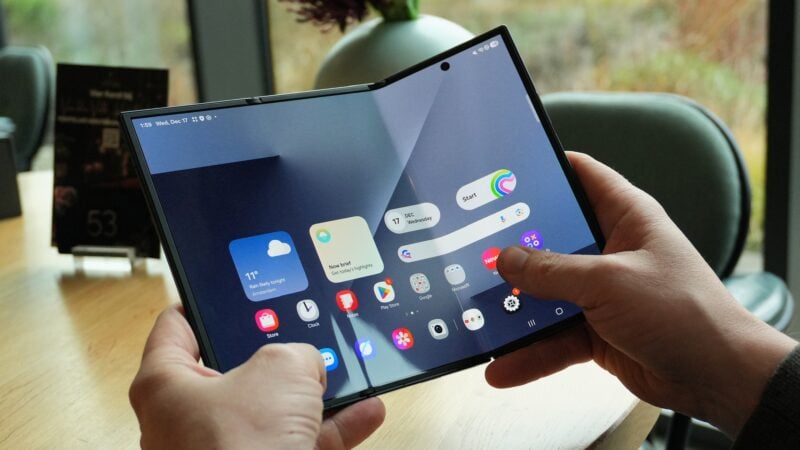
The real changes are on the inside, both when you unfold the phone and under the hood. Samsung’s new Flex Titanium technology makes for the flattest foldable display on a Fold yet. Running your finger over the center of the screen pretty much feels like interacting with a standard non-folding display.
Running your finger over the center of the screen pretty much feels like interacting with a standard non-folding display.
The crease is also less visible on Samsung’s new Folds. Unless you’re actively shining a light on it, you’ll forget it’s there in everyday use. Even out in bright daylight it doesn’t stand out much, thanks to the anti-reflective coating on the inner display — more on that later.
Abhijeet Mishra / SamMobile
Samsung Browser on the Galaxy Z Fold 8 Ultra
Abhijeet Mishra / SamMobile
Samsung Galaxy Z Fold 8 Ultra
Abhijeet Mishra / SamMobile
Samsung Galaxy Z Fold 8 Ultra
The rest of the design is similar to the Galaxy Z Fold 7. At the back, you’ve got the usual Samsung camera island aligned vertically in the corner, which means there’s a lot of wobble when the phone is sitting on a desk.
One thing that’s different is the frame. It’s less flat now, which makes it a bit easier to grip the two halves and unfold the phone. It’s still not as easy to open as the regular Fold 8, but that’s only because the Fold 8 can’t stay unfolded at different angles while the Ultra can. For that, you require some resistance in the unfolding action.
The Galaxy Z Fold 8 Ultra has IP48 protection, so it’s as safe around water as Samsung’s Galaxy S Ultra flagships. But it stops just shy of being rated against particles small enough to officially count as dust.
Those who use multiple SIMs should also be aware that the Fold 8 Ultra only offers a single physical SIM slot. If you’re using two phone numbers, the second will have to operate as an eSIM.
Displays
Abhijeet Mishra / SamMobile
Samsung Galaxy Z Fold 8 Ultra
The Galaxy Z Fold 8 Ultra has 6.5-inch cover and 8-inch foldable displays, and there are plenty of upgrades here, at least on the latter.
What the two screens share is a higher peak brightness. Both can reach 3,000 nits, up from the 2,600 nits of previous Samsung flagships. Will you notice the difference in daily use? Not really. But it’s still a welcome upgrade.
For the cover screen, Samsung has also upgraded the glass: you now get Corning’s Gorilla Glass Ceramic 3 instead of Ceramic 2. It’s a substantial upgrade, too.
Abhijeet Mishra / SamMobile
Galaxy Z Fold 8 Ultra cover screen
Abhijeet Mishra / SamMobile
Samsung Galaxy Z Fold 8 Ultra
Abhijeet Mishra / SamMobile
Samsung Galaxy Z Fold 8 Ultra
Ceramic 3 can survive drops from over 2 meters onto concrete-like surfaces, up from just 1 meter for Gorilla Glass Ceramic 2. It can also survive up to 20 repeated drops on asphalt-like surfaces, double that of its predecessor. We didn’t go out and test Corning’s claims, of course, so we’ll have to take its word here.
The foldable display has an anti-reflective coating that’s rated to cut glare by 50% compared to previous Folds, and you do notice the difference outdoors in daylight and around strong light sources.
For the foldable display, Samsung has bumped up the resolution for a higher pixel density. More importantly, though, the foldable display has an anti-reflective coating that’s rated to cut glare by 50% compared to previous Folds, and you do notice the difference outdoors in daylight and around strong light sources.
Abhijeet Mishra / SamMobile
Samsung Galaxy Z Fold 8 Ultra
It’s one of the reasons you’ll unfold this phone more often than you might have a previous Fold. The cover screen doesn’t get the coating, so once you get used to the lower reflections and glare on the inner display, the reflections on the cover screen start to grate on your nerves.
I found myself using the inner display even on my daily walks because of this, even though I’d normally be scared of exposing the plastic foldable display to the elements. It’s disappointing that Samsung didn’t go all the way here and give both displays all the same features.
Abhijeet Mishra / SamMobile
Samsung Galaxy Z Fold 8 Ultra
Abhijeet Mishra / SamMobile
Samsung Galaxy Z Fold 8 Ultra
Abhijeet Mishra / SamMobile
Browsing the web on the Galaxy Z Fold 8
Samsung also chose to skip a Privacy Display on the Fold 8 Ultra. That might be because OLED panels with Privacy Display are costlier to manufacture. But at the end of the day, it’s one of those omissions that stop the Fold 8 Ultra from feeling like a true Ultra.
Whether the lack of S Pen support falls in that category is up to you. Samsung offered S Pen support up to the Galaxy Z Fold 6, so it’s not technically an Ultra feature. But if you thought it would return this year after going missing with the Fold 7, you’ll be disappointed.
Audio quality
Abhijeet Mishra / SamMobile
Samsung Galaxy Z Fold 8 Ultra
Like the Galaxy Z Fold 7, the Galaxy Z Fold 8 Ultra’s stereo speaker setup suffers because of how thin the phone is. Speaker quality first showed signs of regression with the Galaxy Z Fold 6. The Galaxy Z Fold 7 is where it went down the gutter.
Yes, that might sound harsh, but it’s not wrong. The Galaxy Z Fold lineup had the best speakers of any Galaxy smartphone for the first five years or so. But Samsung compromised them to make its foldables as thin as possible.
Not that most people will complain. No one wants a foldable that feels like a brick in their hands and their pockets, and most folks use some sort of wired or wireless audio gear for any serious media playback on their phones anyway.
But it’s worth keeping in mind, at least if you’re coming from a Galaxy Z Fold 6 or older. The speakers don’t get very loud, and there’s an echo to the sound that makes it feel cheap. The regular Fold 8 has louder, better speakers than the Ultra, but the best quality is available on Samsung’s Galaxy S lineup.
Cameras
Abhijeet Mishra / SamMobile
Samsung Galaxy Z Fold 8 Ultra
This phone may have Ultra in its name, but that doesn’t mean you get the camera setup from the Galaxy S25 Ultra or S26 Ultra. Specifically, you still get a measly 10MP 3x zoom camera. The S26 Ultra has a 10MP 3x telephoto too, except it also has a 50MP 5x shooter alongside it.
Samsung’s Galaxy S series has the better selfie cameras as well. Samsung did manage to fit the Fold 8 Ultra with the 50MP ultrawide from the Galaxy S26 Ultra, though. And the Fold 7’s 200MP main shooter and 10MP inner and cover selfie cameras have carried over, so it’s a pretty competent setup.
The 200MP main camera takes great photos. There’s lots of detail, wide dynamic range, and colors that stay true to life without becoming too dull. That’s the case outdoors during the day, at least.
The 200MP main camera takes great photos.
Low-light and indoor photo quality is good too, but you lose some sharpness and detail. Night mode, which kicks in automatically when needed, can fix the lack of detail in some scenarios, but that sometimes results in an overprocessed look.
Max Jambor / SamMobile
0.6x (ultrawide)
Max Jambor / SamMobile
1x
Max Jambor / SamMobile
0.6x
Max Jambor / SamMobile
1x
Abhijeet Mishra / SamMobile
0.6x
Abhijeet Mishra / SamMobile
1x
Max Jambor / SamMobile
1x
Max Jambor / SamMobile
1x
Max Jambor / SamMobile
1x
Max Jambor / SamMobile
1x
Max Jambor / SamMobile
1x
Max Jambor / SamMobile
1x
The 50MP ultrawide is the best Samsung has used on a foldable so far. Daylight performance is strong, with plenty of detail. It holds up well indoors too, especially once the automatic Night mode kicks in. It also supports autofocus, so you can use it for macro shots, which capture a bit more detail than they did on the Fold 7.
The 3x telephoto is just fine, nothing more, nothing less. It takes decent photos in daylight at 3x zoom and usable photos up to around 10x zoom. Indoors, even with good lighting, only the native 3x shots hold up, and anything past that starts to fall apart.
Abhijeet Mishra / SamMobile
0.6x (ultrawide)
Abhijeet Mishra / SamMobile
1x
Abhijeet Mishra / SamMobile
3x
Abhijeet Mishra / SamMobile
10x
Abhijeet Mishra / SamMobile
20x
Abhijeet Mishra / SamMobile
30x
Abhijeet Mishra / SamMobile
0.6x
Abhijeet Mishra / SamMobile
1x
Abhijeet Mishra / SamMobile
3x
Abhijeet Mishra / SamMobile
10x
Abhijeet Mishra / SamMobile
20x
Abhijeet Mishra / SamMobile
30x
As we noted in our Galaxy Z Fold 7 review, when you have a 200MP main shooter, a dedicated 3x zoom lens almost feels redundant. It would be nice to see Samsung adopt something like the 4x zoom camera on the iPhone 17 Pro. For some reason, though, it insists on sticking with the same 10MP 3x module on every phone, whether it’s a $699 Galaxy S FE smartphone or a $2,100 foldable.
Max Jambor / SamMobile
Portrait
Max Jambor / SamMobile
Portrait
Abhijeet Mishra / SamMobile
Portrait
The selfie cameras are the same 10MP units from the Fold 7, with the inner one having a wider field of view. Both do a good job in good light, with plenty of detail and natural-looking skin tones. Indoor selfies look nice as well, if a little soft.
The best selfies still come from the rear cameras, using the cover screen as a viewfinder. Rear Cam Selfie takes some getting used to when the phone is unfolded, but the results are worth it.
Max Jambor / SamMobile
Selfie
Max Jambor / SamMobile
Selfie
Max Jambor / SamMobile
Selfie
Video quality is excellent from the main and ultrawide cameras; the telephoto is also good in daylight. Every camera on the phone, front and rear, can record at 4K 60 fps, and you can switch between them mid-recording. The ultrawide, like the 200MP main camera, can also record at 8K, made possible by its 50MP resolution.
Samsung’s APV codec is on board too. It holds on to more detail through repeated rounds of editing, at the cost of files that eat through storage. It’s an excellent feature for serious videographers and content creators.
Performance
Abhijeet Mishra / SamMobile
Gaming on Galaxy Z Fold 8 Ultra
Thanks to the Snapdragon 8 Elite Gen 5, the Galaxy Z Fold 8 Ultra is Samsung’s most powerful foldable yet. No matter what you throw at it — general navigation around the interface, running multiple apps side by side, gaming, or AI tasks — it handles everything with ease. Nothing surprising here.
No matter what you throw at it, whether it’s general navigation around the interface, running multiple apps side by side, gaming, or AI tasks, the Fold 8 Ultra handles everything with ease.
There have been some concerns about how the phone handles heat. Unlike the Galaxy S lineup, it doesn’t have a vapor chamber cooling system and instead uses a graphite-based solution.
Does that cause issues in daily use? Not really. Long gaming sessions are where the phone can get warm/slightly hot, but the heat is usually limited to the area around the camera lenses. Most people won’t have their fingers anywhere near there when gaming on the Fold 8 Ultra.
Samsung does seem to have set the Fold 8 Ultra and the Fold 8 to start throttling the Snapdragon chip sooner than the Galaxy S26 series, though, at least in the 3DMark graphics benchmark. The Galaxy S26 Ultra runs up to 44°C in 3DMark and gets higher scores as a result. The Fold 8 Ultra never goes past 38°C and scores lower.
Again, this won’t be a problem for most people outside of benchmarks. But it does suggest Samsung knows the cooling limitations of its foldables and has set temperature limits accordingly.
Software
Abhijeet Mishra / SamMobile
Samsung Galaxy Z Fold 8 Ultra
We covered the software experience in detail in our Galaxy Z Fold 8 review, so I won’t repeat everything here. The experience is largely identical across the two models. The entire Galaxy Z8 lineup runs One UI 9 (Android 17) out of the box, with a big suite of Galaxy AI features.
One advantage on the Galaxy Z Fold 8 Ultra is that it supports Flex Mode. Fold the phone halfway and apps like Camera and YouTube use one half of the screen for controls and the other for the viewfinder or the video.
Abhijeet Mishra / SamMobile
Samsung Galaxy Z Fold 8 Ultra
The Fold 8 Ultra’s main display is also better suited to apps like Instagram and X. The Fold 8 opens directly into a wider mini-tablet layout that’s great for videos. But it’s too short to fit those social media feeds in landscape, so you have to rotate it to portrait. The Ultra doesn’t have that problem.
Abhijeet Mishra / SamMobile
Samsung Galaxy Z Fold 8 Ultra
Abhijeet Mishra / SamMobile
Samsung Galaxy Z Fold 8 Ultra
Abhijeet Mishra / SamMobile
Samsung Galaxy Z Fold 8 Ultra
The trade-off is that the Fold 8 Ultra’s taller, narrower foldable display can’t run three full apps side by side at the same time. One app takes up half the display while the other two split the rest.
Like other recent Galaxy flagships, the Fold 8 Ultra gets seven generations of Android upgrades and seven years of security updates, so you can keep it for several years without worrying about the software feeling outdated.
Battery
Abhijeet Mishra / SamMobile
Samsung Galaxy Z Fold 8 Ultra
Battery capacity is easily one of the biggest upgrades the Galaxy Z Fold 8 Ultra offers. Samsung used a 4,400 mAh battery all the way from the Galaxy Z Fold 3 up to the Fold 7, and the Galaxy Z Fold 2 actually had a 4,500 mAh cell, so all the later models were technically a downgrade.
To put that in perspective, the Flip 7 had a 4,300 mAh battery, just 100 mAh less than the Fold 7. That’s a phone with one small cover screen and one regular phone-sized inner display running on almost the same capacity as a book-style foldable. It tells you how restricted the Folds have been all these years, despite all the software optimization Samsung put in.
The Fold 8 Ultra has excellent battery life as a result. It’s not quite as good as the Galaxy S26 Ultra, which has the same 5,000 mAh capacity, but the Fold 8 Ultra is driving two displays, one of them much larger.
You won’t have any trouble getting through a full day on a single charge, unless your routine involves gaming or recording video for hours on end, or spending all day outside on mobile data. With light use, it can easily last well into the second day.
Best of all, you no longer have to ration your use of the inner display. Previous Folds weren’t built for the kind of workload people buy a book-style foldable to handle in the first place. That’s not the case anymore.
Charging
Abhijeet Mishra / SamMobile
Samsung Galaxy Z Fold 8 Ultra
Samsung has also upgraded charging, but like the displays, this is another half-hearted attempt. The Fold 8 Ultra supports 45W wired charging, which isn’t as high as the S26 Ultra’s 60W but is still a welcome jump. Wireless charging, however, has only gone from 15W to 20W.
And it’s slow. I started wirelessly charging the phone at 1%, and it initially gave me an estimate of 1 hour 34 minutes for a full charge, which made me think it might actually support 25W wireless charging like the S26 Ultra. The phone even says it’s using Super Fast wireless charging, which is supposed to be 25W. But a few minutes later, that estimate had jumped to 1 hour 48 minutes.
Wired charging is fast.
Half an hour took it up to just 29%, and the battery reached 55% after an hour. After 90 minutes, it had only charged to 77%, and a full charge took nearly two hours. An Ultra phone shouldn’t be charging that slowly.
Wired charging is fast, thankfully, and faster than Samsung claims. Samsung told us that half an hour can take the phone up to 65%, but it was closer to 70% for me. A full charge at 45W takes a little under an hour.
Verdict
Abhijeet Mishra / SamMobile
Samsung Galaxy Z Fold 8 Ultra
The Galaxy Z Fold 8 Ultra is the most complete Fold Samsung has made. There are some big upgrades here, like the jump to a 5,000 mAh battery from the 4,400 mAh cell used in the previous five generations, 45W wired charging, a notably reduced crease, and a flatter foldable display.
The Galaxy Z Fold 8 Ultra is the most complete Fold Samsung has made.
Brighter screens and the anti-reflective coating on the inner display are welcome too. And, unlike the Galaxy Z Fold 8, the Ultra keeps Flex Mode and the ability to stay unfolded at multiple angles.
Not every Ultra feature made the cut, though. There’s no Privacy Display and no S Pen support. The Galaxy S26 Ultra charges faster both wired and wirelessly, and you’re still stuck with a 3x zoom camera. For a $2,099 (€2,199 / INR 1,99,999) phone, that’s a longer list of shortcomings than I would have liked.
Still, there’s just enough here to warrant the Ultra tag. Unless you own a Galaxy Z Fold 7, this is a fantastic upgrade from any previous Fold. Just as long as you don’t need the S Pen and you’re willing to pay up.
Samsung Galaxy Z Fold 8 Ultra
What we like
Super thin design
Excellent foldable display with minimal crease, anti-reflection coating
Brightest displays on a Galaxy phone yet
Good main and ultrawide cameras
Smooth flagship performance
Great battery life
45W wired charging
One UI 9 (Android 17) out of the box, seven years of updates






 Apple has no answer to the Galaxy Z Fold 8 Ultra, and Samsung should pounce on it
 Meta just showed Samsung what Galaxy Glasses don't need to become
 Mirror view missing from the Galaxy Z Fold 8 feels like another weird Samsung omission
 iPhone Duo hype proves Samsung was right about foldables all along
 I'm going on holiday, and my Galaxy Z Fold 8 isn't coming with me
 Apple's Siri AI troubles prove Samsung's messy multi-AI strategy was right
 Apple just showed Samsung what foldable buyers care about
 7 years of foldables and my Galaxy Z Fold 8 still can't count screen usage properly
 The Galaxy Z Fold 8 may hold the answer to the only viable compact phone formula


