




Last updated: September 3rd, 2026 at 16:26 UTC+02:00
SamMobile has affiliate and sponsored partnerships, we may earn a commission.
Samsung took the risks first, and Apple now gets to enter a mature foldable market.
Reading time: 5 minutes
Abhijeet Mishra / SamMobile
With less than a week to go until Apple's big iPhone event, there aren't many surprises left. It’s a poorly kept secret that Apple is expected to finally launch its first foldable phone.
Apple might have a few other tricks up its sleeve (including new AirPods with cameras?), but those aren't getting nearly as much attention. Almost all the spotlight is on the foldable.
When you think of foldables, Samsung is usually the first name that comes to mind. Sure, some will point out that Chinese manufacturers are extremely competitive in their home market with some stellar hardware, and they would be right.
But across most of the globe, Samsung is the brand most synonymous with folding screens. For the average consumer shopping in the premium tier, it usually comes down to two choices: Samsung or Apple.
There’s just one major difference between Apple’s upcoming reveal and Samsung’s entry into the space: Samsung launched its first foldable way back in 2019. Nobody knew how the market would react, but Samsung took the leap anyway, and the original Galaxy Fold got the entire tech industry talking.
This wasn't the first time Samsung altered the heartbeat of the mobile industry through sheer hardware. Think back to the original Galaxy Note. Nobody expected a smartphone that massive when it first dropped, and its display looked almost ridiculous at the time. Yet look at where we are today: using a phone with a screen larger than six inches is completely second nature.
Samsung's willingness to experiment goes back even further. In 2003, years before the first iPhone, Samsung released the i700, a touchscreen smartphone running Windows Mobile. Was the software experience anywhere close to what Apple delivered? Of course not. But that’s exactly the point.
Samsung's roots have always been strongly tied to hardware. The company has repeatedly been willing to experiment with new hardware ideas, put them in consumers' hands, and spend years improving them.
Apple, traditionally, plays a different game. Its strength lies in marrying hardware with software, and it's perfectly happy to wait until a category is fully baked before delivering that trademark polished experience. It’s not that Apple won't innovate, it just moves at a different pace.
When looking at the two giants today, Samsung is usually the one taking the initial risk, setting the industry's heartbeat, and spending years refining the concept before Apple even steps into the ring. Foldables are probably the best example of this dynamic.
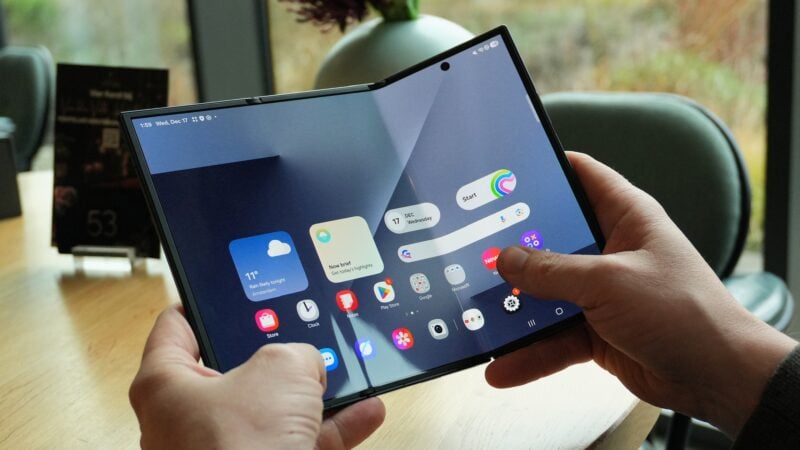
Samsung has now spent eight generations optimizing its foldable phones. Just look at the leap from the original Galaxy Fold to the Galaxy Z Fold 8.
The hardware has evolved tremendously. The displays, hinges, durability, thickness, and overall feel have all seen massive upgrades. Apple, on the other hand, gets to swoop in after a lot of that heavy lifting has already been done.
Because of this, I fully expect the Galaxy Z Fold 8 to keep its edge over Apple's first foldable in a few key areas. Samsung simply has too much of a head start for all its advantages to vanish overnight. That said, I don't expect the gap to be as wide as you’d typically see between an eighth-generation product and a first-generation competitor.
That's where Apple's unique strengths kick in. By waiting for the hardware and software to mature together, and leveraging its tight grip over its ecosystem, Apple might just achieve a level of software optimization you wouldn't normally expect right out of the gate.
Meanwhile, Samsung has spent years improving the foldable software experience alongside Google and the wider Android ecosystem. So while the Galaxy Z Fold 8 will likely feel like the more mature device overall, I won't be surprised if Apple's first foldable gets uncomfortably close.
Ultimately, this gives me a lot of hope for the future of foldable devices. Apple entering the chat will undoubtedly push the entire category forward, giving Samsung even more incentive to perfect what it has been building for more than half a decade.
So, kudos to Apple for finally jumping into the arena Samsung helped build. It’s highly likely Apple will arrive with a stunning first-generation product, and its software prowess might close the gap much faster than critics expect.
But let's not forget one thing: Samsung took the leap first. It launched the original Galaxy Fold when foldables were still an experiment and then spent eight generations turning that experiment into products such as the Galaxy Z Fold 8.
Apple prefers to wait. But when it finally arrives, its tightly integrated ecosystem tends to set a brand-new pace for the industry.
And that's exactly how I view the dynamic between these two tech giants. Without a heartbeat, there can be no pace. Apple sets the pace, but Samsung sets the heartbeat.
Enjoy next week's event, Apple. Welcome to the fold.