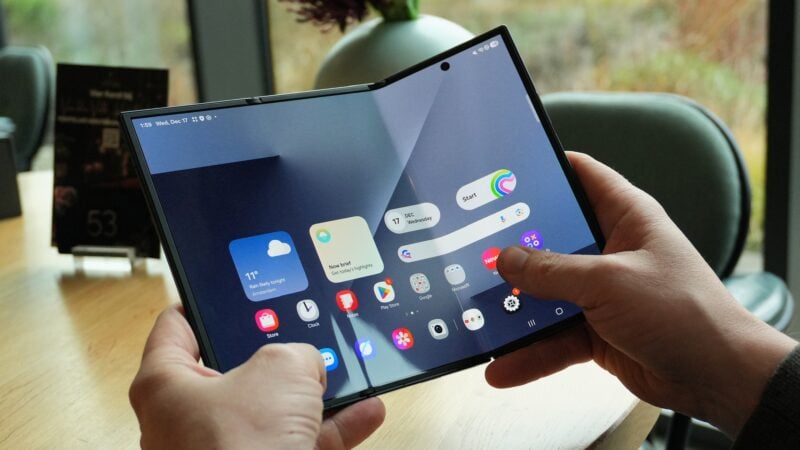
The Galaxy Z Fold 8 matches the iPhone Duo’s 7.6-inch inner display while being 53g lighter, thinner when closed, and slimmer when unfolded.
Samsung achieved the lighter design by redesigning the display support, internal parts, frame, battery space, and cooling rather than relying on one material change.
The Fold 8 keeps a 4,800 mAh battery, but it drops S Pen support, which may matter to note-takers and sketch users.
The Galaxy Z Fold 8 and iPhone Duo both have a 7.6-inch inner display, but Samsung has fitted its passport-style foldable into a much lighter and thinner phone.
The Fold 8 weighs 201g against Apple’s 254g and measures 9.7mm when closed, compared with 11.3mm. When unfolded, the Fold 8 is slimmer again at 4.5mm rather than 5.2mm. That makes the Fold 8 roughly 21% lighter, despite offering the same screen diagonal.
Put another way, Samsung’s phone weighs roughly one fifth less despite giving you the same-sized inner display. That makes the obvious question much more interesting: where did Samsung find those 53 grams?
For me, that difference matters because of how I use a foldable phone. When you’re reading an article, editing photos, or getting serious work done, you can be holding the phone unfolded for a while.
Abhijeet Mishra / SamMobile
Samsung Galaxy Z Fold 8
I’m more likely to notice that difference during one of those longer sessions than during a quick glance at a notification. And once I’m done, the Fold 8’s slimmer folded body also takes up less room in my pocket.
What’s interesting is how Samsung made the Fold 8 so light. It reworked the structure beneath the display, the layout of the internal components, and the space used by the battery instead of shedding the weight by just opting for a new material.
Looking at all those choices versus Apple’s approach gives the Fold 8’s weight advantage more, well, weight than the numbers alone.
SamMobile
Infographic Corrected Original Phones
This comparison shows the engineering details available for the two phones, not a measured breakdown of how much each component contributes to the 53g difference.
The clearest way to look at that gap is therefore to compare how the two companies approached the same problems: supporting a folding screen, building the frame, finding room for the battery and keeping the processor cool.
Samsung made the screen’s support structure do more in less space
A folding display has to bend when the phone closes, but it also needs support when you open it and press on the screen. Samsung’s Flex Titanium technology uses two layers beneath the display to handle those jobs.
The first is a titanium-alloy film roughly a third of the thickness of a human hair. It supports the screen through all the repeated folding without requiring a thick reinforcing layer.
Under the titanium-alloy film is a titanium plate with tiny openings along the fold, allowing it to bend while supporting the display when it is open. Samsung has changed both the material beneath the screen and the way the display’s support structure bends.
Samsung
Galaxy Z Fold 8's Flex Titanium hinge system
Apple puts high-strength glass above and below the folding panel. Adhesives let those layers slide against each other as the phone closes, while a titanium plate underneath provides support.
Apple’s design allows movement between the reinforced layers, rather than relying on the screen’s flexibility alone. Both phones use titanium beneath the screen, but the supporting layers around it are different.
Samsung says its revised display assembly is 10% thinner than before, leaving more room behind the screen. The redesigned structure also improves flatness and makes the crease less visible.
The frame highlights another choice: Samsung uses Advanced Armor Aluminum on the outside, while Apple uses Grade 5 titanium for the Duo’s exterior and aluminum for its internal structural frame. Samsung still uses titanium where it needs it: beneath the folding display.
I find that more useful than an aluminum-versus-titanium argument. What matters to me is the weight and feel of the final product, not whether the same premium material runs through the entire device.
The Fold 8’s 201g weight is a result of hundreds of smaller changes
If the display explains one part of Samsung’s approach, much of the rest comes from far less prominent components hidden throughout the phone.
Samsung says its engineers reviewed approximately 270 components and more than 180 types of supporting parts. There was a lot more to do than redesign the display or slim down the frame.
The circuit board was redesigned, around 15 types of supporting parts were eliminated, and others were combined into single structures. Some changes saved as little as 0.001g. Samsung also changed its manufacturing process to keep thinner metal supports flat instead of letting them warp during production.
This is where Samsung’s experience with foldables helps. Engineers need to know how to make a smaller part reliably, fit components together more efficiently, and work out when a separate support is no longer needed.
Of course, those changes have to hold up in the final product, and Samsung says the latest Galaxy Z series went through more than 100 reliability tests covering repeated folding, drops, pressure, moisture and debris.
Most owners will never see the work that goes on behind the scenes, but they will appreciate the phone’s lower weight every single day they use it.
The battery shows why saving space matters
A thinner phone would impress me less if Samsung had sacrificed battery capacity to achieve it. But that’s not the case: the Fold 8 has a 4,800 mAh battery and uses silicon-carbon technology to fit more energy in the available space.
Samsung worked on both sides of the problem: it made more room around the battery and made better use of the space occupied by the battery. The space recovered around the display helps make that combination possible within a slimmer (9.7mm) body.
That is why the battery belongs in the same story as the thinner screen supports. Samsung has worked on both to make a slimmer phone practical.
Abhijeet Mishra / SamMobile
Samsung Galaxy Z Fold 8
Samsung’s approach to cooling was part of the process as well. Apple connects its processor to a custom vapor chamber to move heat away from the chip. Samsung uses improved graphite and bonded metal layers to spread heat through the device, with the metal combination designed to provide the thermal performance it needs while reducing weight.
Again, the two companies are solving the same problem in different ways. Samsung’s solution fits into a wider effort to reduce the amount of space and material needed throughout the Fold 8, rather than treating thinness as an exterior design exercise.
One difference still matters to me: the Fold8 does not support the S Pen, while Apple has announced Apple Pencil support for the Duo later this year. For users who prioritize handwritten notes, sketching or document markup, that is a meaningful distinction. I appreciate the Fold8’s lighter design, but I would still like Samsung to bring back pen support.
Samsung’s experience is visible in the finished phone
All of Samsung’s choices show how much work went into the Fold 8. Its aluminium exterior hides thin titanium supports under the display. Changes to smaller components free up space for the battery, while the battery and cooling hardware fit within the same slim body.
For the way I use a foldable, the final result is important. I want a large screen for tasks like reading, photo editing, and multitasking without feeling as though I’m carrying a second device.
Samsung did not get the Fold 8 down to 201g by changing one material. It reconsidered how the entire phone fits together. That is ultimately what makes the 53g difference interesting. The number is easy to put in a headline. The real story is how many different parts of the Fold 8 Samsung had to rethink to get there.


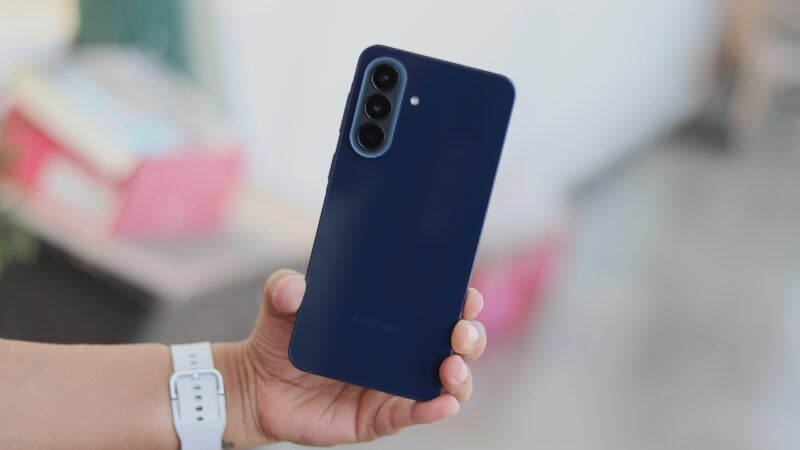
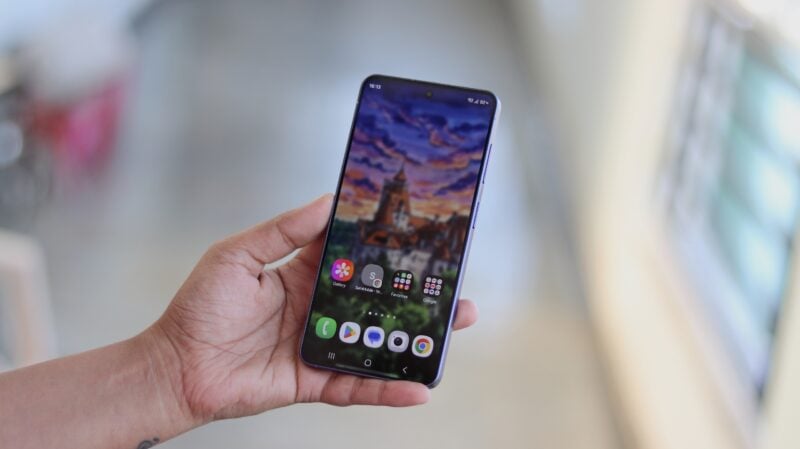
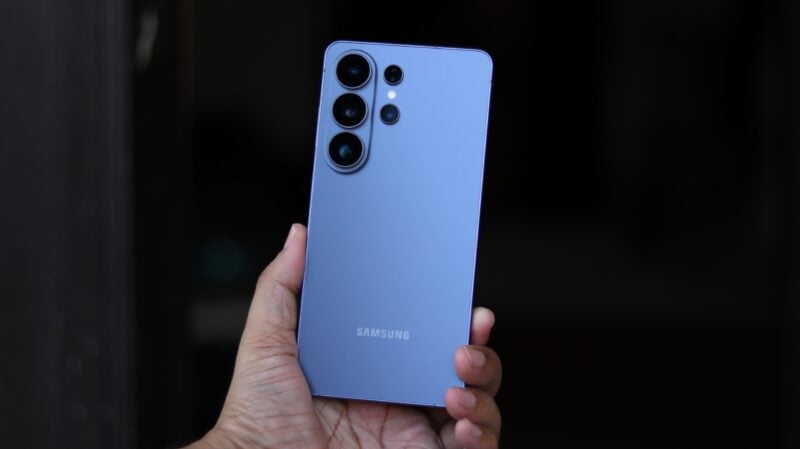





 The Galaxy Z Fold 8’s 53g advantage over the iPhone Duo is more than a number
 I’m not convinced Apple’s matte iPhone Duo display is the better solution
 Apple has no answer to the Galaxy Z Fold 8 Ultra, and Samsung should pounce on it
 Meta just showed Samsung what Galaxy Glasses don't need to become
 Mirror view missing from the Galaxy Z Fold 8 feels like another weird Samsung omission
 iPhone Duo hype proves Samsung was right about foldables all along
 I'm going on holiday, and my Galaxy Z Fold 8 isn't coming with me
 Apple's Siri AI troubles prove Samsung's messy multi-AI strategy was right
 Apple just showed Samsung what foldable buyers care about



