



Last updated: August 6th, 2026 at 11:30 UTC+02:00
SamMobile has affiliate and sponsored partnerships, we may earn a commission.
Center-etched thin glass (CTG) can have different thickness and physical properties in different areas.
Reading time: 3 minutes
Abhijeet Mishra / SamMobile
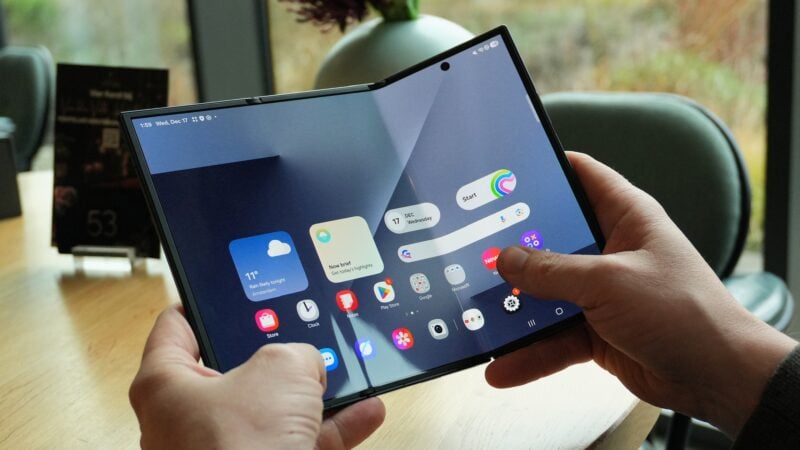
Samsung has come a long way with foldable displays for smartphones. For its initial Galaxy Z devices, the brand used colorless polyimide (CPI) before transitioning to ultra-thin glass (UTG), which is found in its latest foldables. Compared to CPI, UTG offers a flatter, smoother surface, reduces crease visibility, and improves durability.
Even so, it still falls short of delivering the experience of a conventional smartphone display. The crease remains visible under certain conditions, while the surface still isn't as hard or as smooth as traditional cover glass, limiting both its premium feel and durability. Samsung Display now appears to be working on addressing those shortcomings.
On X, well-known tipster Ice Universe says that Samsung Display is developing a new foldable display technology called center-etched thin glass (CTG).
With UTG, the entire sheet of glass has a uniform thickness. However, different parts of a foldable display have different requirements. Most of the display requires a thicker, stronger layer that provides a flat, smooth, glass-like surface and high durability. The folding section, on the other hand, requires greater flexibility. Since the entire UTG layer has the same thickness, Samsung has to strike a balance between strength and flexibility.
As a result, neither area is fully optimized. The rigid sections cannot be as strong as they ideally could be, while the folding section remains thicker than desired, making the crease more noticeable and increasing stress on the glass over time, potentially leading to microcracks.
CTG aims to solve this limitation by giving different sections of a single sheet of glass different thicknesses and physical properties. The non-folding areas can remain thicker to maximize strength, improve durability, and deliver an even flatter, smoother, glass-like surface. Meanwhile, the folding section can be made thinner to improve flexibility.
In theory, this approach would allow Samsung to offer the best of both worlds: a stronger, smoother display with a less visible crease while reducing stress on the folding area to improve long-term durability.
However, developing CTG is far from straightforward, especially at the scale required for mass production. Manufacturing a single sheet of glass with varying thicknesses and material properties is an extremely demanding engineering challenge.
If not executed precisely, it could result in inconsistent surface texture, uneven reflections, and optical distortions. If Samsung Display can overcome these hurdles, CTG could mark the next major breakthrough in foldable display technology.
At the moment, there's no word on when Samsung Display plans to debut CTG or when Samsung Electronics could start using it in Galaxy Z series devices. Since the technology is reportedly still in the early stages of development, it's unlikely to make its debut with the Galaxy Z Fold 9 Ultra, Galaxy Z Fold 9, Galaxy Z Flip 9, or Galaxy Z TriFold 2.