Last updated: January 13th, 2026 at 09:10 UTC+01:00
SamMobile has affiliate and sponsored partnerships, we may earn a commission.
Apple and Samsung have reportedly decided to use different materials to support the foldable OLED panel's structure.
Reading time: 3 minutes

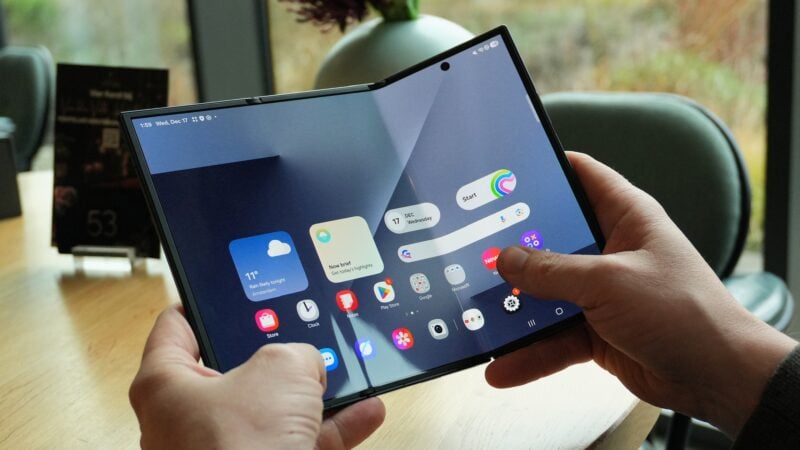
We recently brought you a first look at Samsung’s crease-less foldable OLED panel from CES 2026. At the time, it was expected that the panel could be used in both the Galaxy Z Fold 8 and Apple’s first foldable iPhone. Now, a new report suggests that while the Galaxy Z Fold 8 will indeed use this display, the foldable iPhone will feature a slightly different version.
ZDNet Korea reports that the crease-less OLED panel showcased at CES 2026 will be used in the Galaxy Z Fold 8. However, it will not be used in Apple’s foldable iPhone, as the materials chosen by Apple and Samsung MX (Samsung’s mobile division) to reinforce their foldable OLED panels are completely different. While Apple has reportedly opted for glass, Samsung MX has chosen a metal plate.

Although the OLED layer itself is the same in both panels, the two variants use different materials for structural support. Traditionally, a polyethylene terephthalate (PET) film is used to support foldable OLED panels. However, Samsung Display has replaced it with a metal reinforcing plate to provide better structural stability. Apple’s foldable OLED panel, on the other hand, is said to use glass as the supporting material.
All OLED panels used in smartphones consist of several layers, including a polyimide (PI) substrate, a backplate, an OLED element, a touch sensor, and ultra-thin glass (UTG). Some of these layers are bonded using optical clear adhesive (OCA), which acts as both a buffer and an adhesive between layers.
Samsung Display has modified this OCA layer to reduce the wrinkles that form when an OLED panel is folded. The change lowers stiffness compared to previous-generation foldable OLED panels, allowing more flexible cushioning between the OLED layer and the UTG layer during folding. This modification plays a key role in minimizing visible creases.
Both the Galaxy Z Fold 8 and Apple’s foldable iPhone are expected to launch in the second half of this year. Samsung is also rumored to be developing a variant of the Galaxy Z Fold 8 with a wider screen, similar to that of the foldable iPhone.
It will be interesting to see how these devices compete. Apple could bring fresh ideas in UI design and app optimization, while Samsung may retain an edge in camera hardware and charging speeds.
The Galaxy Z Fold 8 is rumored to feature a 200MP primary camera, a 50MP ultrawide camera, and a 10MP telephoto camera. The foldable iPhone is rumored to have a dual-camera setup on the rear. Both Apple and Samsung are expected to use a side-mounted fingerprint reader.
Apple is widely expected to capture a significant share of the foldable smartphone market this year, as millions of loyal iPhone users could rush to buy the company’s first-ever foldable device.

Asif is a computer engineer turned technology journalist. He has been using Samsung phones since 2004, and his current smartphone is the Galaxy S23 Ultra. He loves headphones, mechanical keyboards, and PC hardware. When not writing about technology, he likes watching crime and science fiction movies and TV shows.