Last updated: April 16th, 2026 at 06:20 UTC+02:00
SamMobile has affiliate and sponsored partnerships, we may earn a commission.
Easy to like, difficult to love.
Reading time: 10 minutes

Abhijeet Mishra / SamMobile
When rumors about the Galaxy S26 series first started hitting the internet, Samsung was said to be cancelling the Plus model and replacing it with the Edge. But nothing really changed this year: Samsung once again launched three new models, with the Plus sitting between the base and Ultra variants.
The base Galaxy S26 and the S26+ aren’t particularly exciting. Samsung has clearly focused most of its attention on the Ultra, while the other two bring the usual yearly upgrades — a newer chipset, the latest software out of the box, and a healthy dose of AI features.
That makes the Galaxy S26+ a familiar proposition. It follows the same formula as previous Plus models, offering a bigger screen and battery than the base model, and it comes with a higher price tag than its predecessor.
So, is the Galaxy S26+ a well-rounded package that justifies that higher price? Here’s our review.

Abhijeet Mishra / SamMobile
Samsung Galaxy S26+
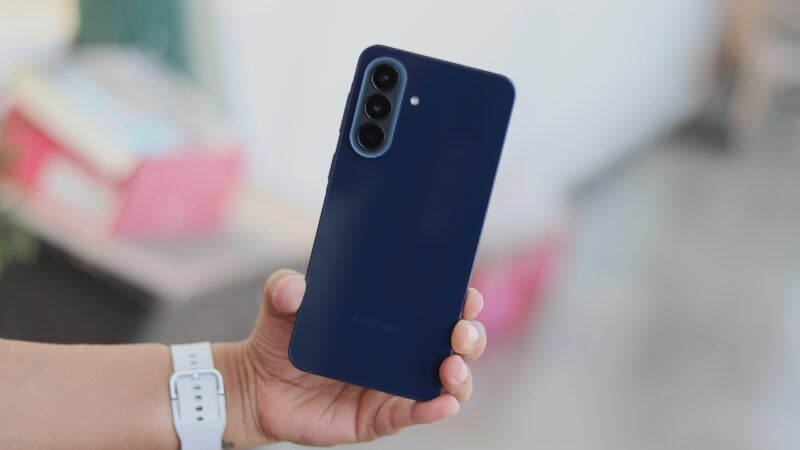
The Galaxy S26+ doesn’t bring any significant design changes or improvements. That’s not necessarily an issue. Samsung’s flagship phones have long been well built and feel in line with their premium price tags. They are durable as well, as various bend and torture tests have shown over the years.
Like the S25+, the S26+ features Gorilla Glass Victus 2 on the front and back, along with an aluminum frame. There’s no upgrade to Gorilla Glass Armor for the display, no anti-reflection coating, and no Privacy Display, but more on that in the display section later.

Abhijeet Mishra / SamMobile
Galaxy S26+

Abhijeet Mishra / SamMobile
Samsung Galaxy S26+ cameras
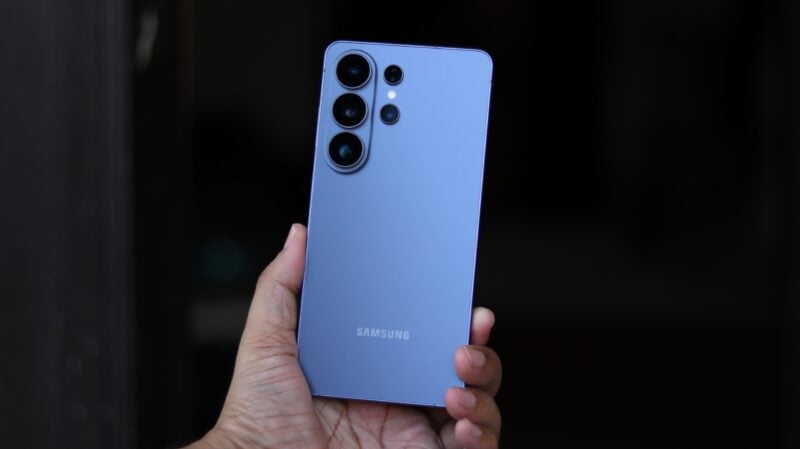
The only visible change is on the back, where the camera lenses are no longer separate. Samsung has returned to a camera island that houses all three lenses, a design we first saw on the Galaxy Z Fold 7 last year.
Aside from that, there are no other notable changes. Samsung continues to offer IP68 water and dust resistance, which protects the phone for up to 30 minutes in 1.5 meters of water. Some competing phones, including the iPhone, can withstand longer submersion, but Samsung has not made any changes to IP protection on the S26 series.

Abhijeet Mishra / SamMobile
Galaxy S26+
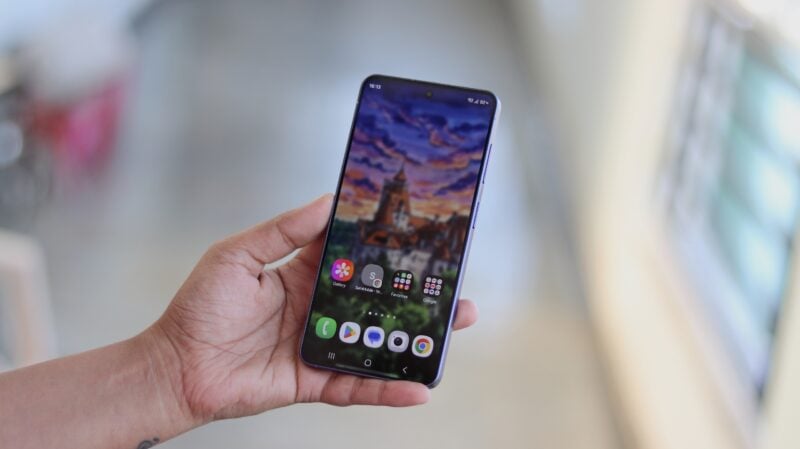
The Galaxy S26+ sports the exact same display as the Galaxy S25+. It’s a 6.9-inch Dynamic AMOLED 2X panel with a 120Hz refresh rate, QHD+ (1440 x 3120) resolution, and a peak brightness of 2,600 nits.
This is a proper flagship display that offers an excellent experience for all kinds of content and gets more than bright enough when needed. It’s an 8-bit panel, not a 10-bit one, but Samsung’s mDNIe technology works in the background to reduce issues typically associated with 8-bit displays, like color banding, which was an issue on the Galaxy S25 series.
Unfortunately, the S26+ does not have any anti-reflective coating on its display, while Apple offers this feature across all iPhone 17 models, including the iPhone 17e. Samsung could have done something similar, but it has chosen to do the absolute minimum, which is a general theme across both the base and Plus Galaxy S26 models.

Abhijeet Mishra / SamMobile
Galaxy S26+

Abhijeet Mishra / SamMobile
Galaxy S26+
The Galaxy S26+ features the same ultrasonic fingerprint sensor underneath the display as its predecessors, but Samsung has added an interesting way to improve detection accuracy. A new feature scans your fingerprint 10 additional times after you’ve set up the fingerprint sensor.
Sound quality from the Galaxy S26+ stereo speaker setup isn’t bad. It’s just that the speakers on the Galaxy S26 Ultra are so good compared to every other Samsung phone, including the Galaxy Z Fold 7, that it’s hard to be impressed by the S26+.

Abhijeet Mishra / SamMobile
SamMobile website open on the Galaxy S26+'s screen
The S25 Ultra already had excellent speakers, and the S26 Ultra improves on them further. The Galaxy S26+, on the other hand, sounds similar to the S25+. It’s possible this is partly because Samsung only decided to launch a Plus model later in the development cycle after cancelling the S26 Edge.
A teardown showed that both the base S26 and the S26 Ultra use different speakers compared to their predecessors, while on the S26+, only the earpiece speaker is different from the S25+. That suggests Samsung could have offered an upgrade if it hadn’t spent time on the S26 Edge, though this is just speculation.

Abhijeet Mishra / SamMobile
Rear-facing cameras of the Samsung Galaxy S26+
The camera specs on the Galaxy S26+ are more or less the same as the S25+ (50MP main, 12MP ultrawide, 10MP 3x telephoto, and 12MP selfie), with the only notable difference being a wider field of view for the selfie camera. So, unlike the Galaxy S26 Ultra, the S26+ doesn’t offer a jump in quality in the photography experience.
Daylight performance outdoors with the main camera is strong, with excellent detail and dynamic range and colors that are just punchy enough while still staying close to what you see with your eyes. You can also enable the 24MP resolution option using the Camera Assistant app for even better detail without a big increase in file sizes.
Low-light and indoor performance leaves something to be desired, at least without switching on Night mode. The narrower aperture compared to the S26 Ultra’s main camera also means low-light photos can still suffer from noise and blur if your subject isn’t standing completely still.
The ultrawide tells a similar story. Outdoors in daylight, pictures have a good amount of detail despite the lower resolution compared to the S26 Ultra’s 50MP ultrawide. Indoors it does an okay job, but in low-light conditions, it’s best to avoid it altogether.

Abhijeet Mishra
0.6x (ultrawide)

Abhijeet Mishra
1x

Abhijeet Mishra
3x

Abhijeet Mishra
10x

Abhijeet Mishra
20x

Abhijeet Mishra
30x

Abhijeet Mishra
0.6x

Abhijeet Mishra
1x

Abhijeet Mishra
3x

Abhijeet Mishra
10x

Abhijeet Mishra
20x

Abhijeet Mishra
30x
The 3x zoom camera is also at its best outside during the day, though there isn’t a ton of detail to speak of. Up to 10x magnification it remains usable, but beyond that, there’s a heavy watercolor effect. It’s disappointing that even today, Samsung is still keeping powerful zoom exclusive to Galaxy S Ultra models, while companies like Apple and Google offer the same zoom cameras across multiple models in their flagship lineups.

Abhijeet Mishra
3x

Abhijeet Mishra
3x

Abhijeet Mishra
0.6x

Abhijeet Mishra
1x

Abhijeet Mishra
1x

Abhijeet Mishra
Portrait (1x)

Abhijeet Mishra
0.6x

Abhijeet Mishra
1x

Abhijeet Mishra
3x

Abhijeet Mishra
Portrait (3x)
The selfie camera on the S26+ is excellent. It keeps plenty of detail and now captures more accurate skin tones. That’s the case for both daytime and indoor selfies. Low-light selfies aren’t the best, but enabling the flash can help with those.

Daniel Scuteri
S26+ selfie

Max Jambor
S26+ selfie

Max Jambor
S26+ selfie

Daniel Scuteri
S26+ selfie

Abhijeet Mishra
S26+ selfie

Abhijeet Mishra
S26+ selfie
For video recording, the big highlight is Horizontal Lock. Horizontal Lock keeps the image in your video perfectly straight and upright, even if you tilt or rotate the phone while recording. It works incredibly well, and unless you move the phone really frantically, it’s nearly impossible to tell that the phone wasn’t held steady when the video was recorded.
Horizontal Lock is part of the camera’s existing Super Steady mode. While Super Steady uses the ultrawide camera to record videos, Horizon Lock works with the main camera as well. However, the feature only works at up to QHD resolution at 60fps, not 4K.
Also missing on the S26+ (and the base S26) is support for APV codec. Samsung’s answer to Apple’s ProRes, this codec is designed for content creators who do serious video editing and require footage to retain detail even after multiple rounds of editing. You can, however, record log footage, which is a feature Samsung introduced with the Galaxy S25 series.

Abhijeet Mishra / SamMobile
Galaxy S26+
This year, Samsung is back to using its in-house Exynos processor for the Galaxy S26 and S26+ in most markets. The Exynos 2600 is, on paper, Samsung’s best chip yet. It’s efficient and has more than enough power, even if its performance is closer to last year’s Snapdragon 8 Elite than the Snapdragon 8 Elite Gen 5 that powers the S26 Ultra.
In practice, I found no fault with the performance on this phone. It’s fast and smooth — every adjective that you can use to describe performance on a modern flagship phone applies to the S26+. The problem is more about the unfairness of it all: customers in most countries don’t have the option to buy an S26+ with the best smartphone chip.
The Exynos 2600 handles AI tasks extremely well and at the same speed as the S26 Ultra. Considering AI is Samsung’s primary focus these days when it comes to marketing, that’s a good thing.
The S26+ also performs excellently in high-end Android games. While the GPU scores lower than the Snapdragon 8 Elite Gen 5 in benchmarks, real-world frame rates are quite similar across both devices.
One thing to keep in mind is game settings. Since the Exynos 2600 is a new chip, some games treat it as an unknown processor and default to medium graphics settings. You may need to manually set everything to the highest possible levels, which isn’t an issue on the S26 Ultra.

Abhijeet Mishra / SamMobile
Galaxy S26+
The Galaxy S26+ runs One UI 8.5 based on Android 16. It’s a fast and responsive experience, and there’s no shortage of customization options. Galaxy AI features feel well-integrated rather than tacked on, which has been Samsung’s clear focus over the past couple of One UI releases.
There’s a good range of AI-powered tools on offer, from smarter notifications and context-aware suggestions to improved photo and video editing features. Bixby has also taken a step forward this time around.
Samsung is promising seven years of OS and security upgrades, as is the norm for Galaxy flagships since 2024. For a full rundown of the software experience, head over to our Galaxy S26 Ultra review.

Abhijeet Mishra / SamMobile
Galaxy S26+
The Galaxy S26+ has a 4,900 mAh battery, which is just 100 mAh smaller than the Galaxy S26 Ultra. And while that isn’t a huge difference physically, I feel the difference in battery life between the two phones is more than what that number would suggest.
Still, that doesn’t mean battery life on the Galaxy S26+ isn’t great. You can easily make it through a full day of mixed use. With light use, you can comfortably wait until early afternoon the next day before the phone needs to be charged.
Samsung has done a half-hearted job when it comes to charging upgrades. Wired charging still maxes out at 45W, not 60W unlike the Galaxy S26 Ultra. Wireless charging has received an upgrade to 20W, which is a mere 5W faster than previous Galaxy S flagships.
A full charge over a wire takes between 60 to 70 minutes, and half an hour of charging gets you around 55-70% charge. Nothing to scoff at, but nothing impressive in the current year. As for wireless charging, I couldn’t test it as I didn’t have a magnetic case, but I imagine a full charge takes at least two hours.

Abhijeet Mishra / SamMobile
Samsung Galaxy S26+
So, should you buy the Galaxy S26+? Honestly, it’s a tough one. Samsung has raised the price but hasn’t given you much in return, and the same problem that has plagued the Plus model for years remains: there’s still not enough separating it from the base S26 beyond a larger display and a bigger battery.
On top of that, most buyers outside the US and China are paying a premium price for a phone that doesn’t even run the best chip available. The Exynos 2600 is a capable processor, but knowing that the Snapdragon 8 Elite Gen 5 exists and you’re not getting it is hard to ignore.
That said, the S26+ is still a good phone, and anyone buying it will have a genuinely good experience, as long as they’re not expecting the best Samsung has to offer. It’s a particularly solid choice if you’re upgrading from an S23+ or older, or stepping up from a mid-range phone to a proper flagship for the first time.
If neither of those applies to you, though, the calculus gets harder. S25+ owners have no real reason to upgrade, and if you want the best Samsung cameras or the fastest chip, the Ultra is where you should be looking. And if you’re tempted to save some money and go for the S25+ instead, that honestly wouldn’t be a bad decision, either.