
Epic deals Galaxy Z Fold7 and Galaxy S25 Ultra
Last updated: February 18th, 2026 at 20:15 UTC+01:00
SamMobile has affiliate and sponsored partnerships, we may earn a commission.
An amazing product and a real statement piece.
Reading time: 8 minutes
Samsung’s Galaxy Z TriFold is basically the point where foldables stop feeling like a phone that opens wider and start feeling like a real attempt to replace a tablet.
It’s a tri-fold device that expands into a massive 10-inch screen, but it still stays pocketable enough that you’ll actually carry it. And that’s the important part: it’s not a concept, it’s a real product that feels surprisingly mature.
The obvious catch is the price. At $2,899, this isn’t meant to be a mainstream phone. It’s a premium device for early adopters and people who specifically want one device that covers both phone and tablet use.
Depending on the market, availability can vary, but either way, the TriFold is positioned as a flagship-class niche product. You don’t buy it because it’s a smart deal, you buy it because you want this exact experience.
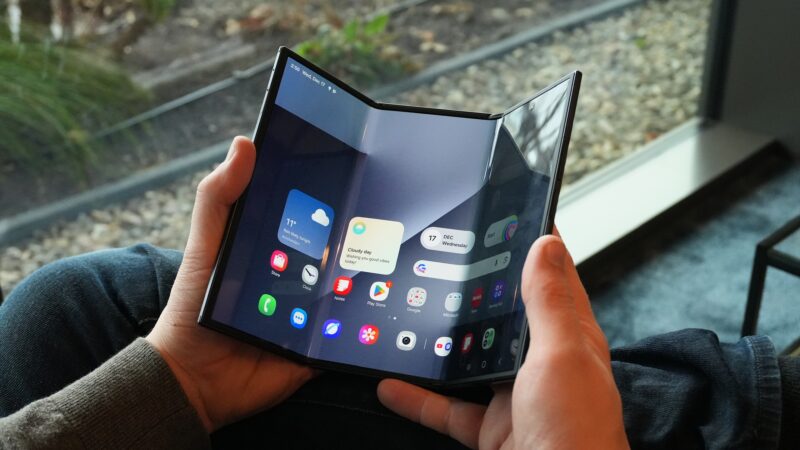
The TriFold is an engineering flex, and it shows immediately. It’s surprisingly thin for what it is, even compared to Samsung’s older foldables that sometimes felt chunky while offering less complexity.
The hinge system feels durable and reassuring, which matters because you’re going to open and close this thing constantly. It doesn’t give off that delicate “be careful with me” vibe.
The TriFold is an engineering flex, and it shows immediately.
Samsung’s Crafted Black finish is an interesting touch and helps the device stand out. It uses a sophisticated ceramic and glass-fiber reinforced polymer, but it’s also a fingerprint magnet. You’ll see smudges quickly.
The inclusion of a case in the box is the right decision at this price and it adds basic protection from day one. The IP48 water and dust resistance rating is another confidence booster, because on foldables it still feels like a luxury feature.
At 309 grams, it’s not lightweight. On paper that sounds heavy, but in daily use it doesn’t feel as extreme as the number suggests, mostly because the weight distribution works in its favor.
Thickness is also a story of contrasts. Folded, it measures 12.9 millimeters, so it’s not exactly slim in your pocket, but it’s acceptable for a tri-fold. Fully unfolded, it gets down to 3.9 millimeters at the thinnest point, which is honestly crazy and feels amazing in hand.
There are a couple of physical downsides. The camera bump makes the phone wobble a lot on a flat surface. The speakers are placed at the top and bottom of the middle section and they sound really good for a foldable, but compared to a slab flagship like the Galaxy S25 Ultra they lack a bit of raw power. That’s likely the price you pay for the extreme thinness.
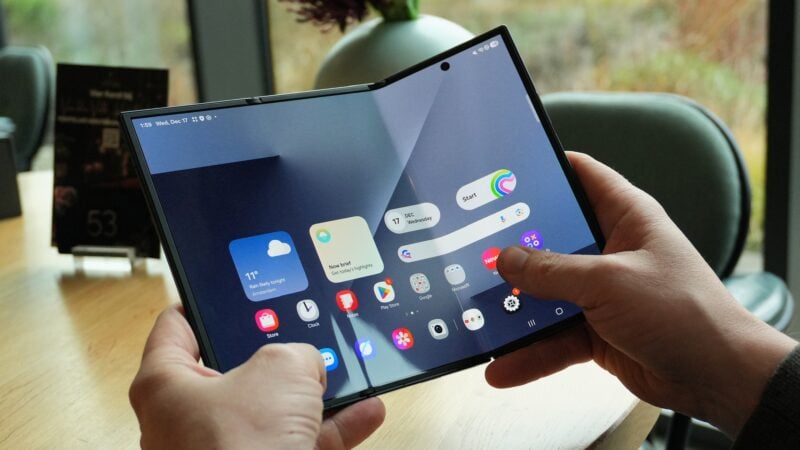
This is where the TriFold makes sense. The 120 Hz 6.5-inch outer screen is comfortable for everyday phone tasks, so you’re not forced to open the device constantly. But the real reason you buy it is the inner screen. Once unfolded, you get a massive 10-inch foldable display that feels more like a tablet than a phone.
It’s excellent for watching movies and YouTube, and it’s surprisingly fun for social media. Scrolling TikTok or Instagram in vertical mode on a huge screen sounds ridiculous until you actually do it, then it becomes oddly addictive.
The bigger display also makes Samsung’s software features more meaningful. Samsung DeX works without a secondary monitor, which turns the TriFold into a legit portable workstation when you want it.
Once unfolded, you get a massive 10-inch foldable display that feels more like a tablet than a phone.
Multitasking is another strong point. You can open three apps at once and still properly view and use each one. Even if you don’t multitask heavily every day, it’s nice that the device finally makes it feel practical instead of cramped.
One big advantage over some competing tri-fold ideas is that the inner screen is always protected when the device is fully shut. That’s exactly how it should be. Samsung even added a sequential folding safety feature: you must fold the left panel first and then the right. If you try to do it incorrectly, the phone will give you a haptic buzz and an on-screen warning to protect the display.
The main annoyance is that you have to fully unfold both sides to use the inner display.
The main annoyance is that you have to fully unfold both sides to use the inner display. It would be great if you could unfold just one side and use it like a Fold 7-sized device for quick “medium mode” situations. Right now, it’s basically cover screen or full tablet, with less flexibility in between.
The camera system is basically what you get on the Fold 7, which is a good thing because Samsung’s top foldable cameras are now genuinely competitive. The main camera is a 200MP wide sensor with OIS, backed up by a 10MP 3x telephoto and a 12 MP ultrawide. For selfies and calls you get a 10MP front camera, plus a 10MP cover camera.
In practice, the 200MP main camera is the star and delivers the kind of output you’d expect from a premium Samsung device. The 3x telephoto is useful for portraits and zoom shots without leaning on digital cropping, and the ultrawide is reliable for travel and group photos. The front cameras are fine for video calls and quick selfies, and the form factor often makes it convenient to use the main cameras for selfies anyway.
Since the cameras on the TriFold are not new, check out our Galaxy Z Fold 7 review for a detailed look at the camera quality and experience.
Performance is exactly what you want from a device at this price. The TriFold uses the Snapdragon 8 Elite, the same chip as the Fold 7. It’s not the newer 8 Elite Gen 5, which makes sense given how long this device has likely been in development. In real-world use, it doesn’t feel like a compromise. Daily apps, games, and multitasking all run flawlessly.
Samsung also didn’t cheap out on memory. You get 512GB base storage and 16GB RAM, which is plenty for most people and helps the TriFold feel properly flagship-level and future-proof.
The TriFold runs One UI 8 on Android 16, and it feels exactly like modern Samsung software should. It’s smooth, customizable, and stable. If you’ve used other Samsung devices like the Fold 7, it’ll feel familiar, but the TriFold benefits more from the software because the bigger screen makes features like multitasking and DeX far more useful.
DeX is a standout here, because it gives you a desktop-like workflow on a device that can also become a 10-inch tablet. That’s what turns the TriFold from cool hardware into something you can actually build a daily routine around. Adding a keyboard and mouse lets the TriFold easily replace your notebook for travels to do basic things like working on a PowerPoint, editing documents or researching on the web.
As you would expect, the full suite of Galaxy AI features is present on the TriFold. For the long haul, Samsung is promising seven years of OS and security updates, meaning this device is theoretically supported until 2033.
Samsung equipped the TriFold with a 5,600 mAh battery, the largest battery in a Samsung foldable so far and every other Galaxy flagship in general, and the results are strong. In real life, you’ll spend a lot of time using the device closed on the outer screen, and in that mode battery life is excellent.
If you unfold it and use the big inner display for long sessions, the battery drains faster, of course, but that’s expected with a 10-inch screen.
With a realistic mix of cover and main display use, it easily lasts a full day. Charging is also solid. You get up to 45W wired charging, and 15W wireless charging. Wireless is what I’d use overnight, and wired is fast enough for quick top-ups during the day if needed.
The Galaxy Z TriFold is an amazing product and a real statement piece. The engineering is impressive, the thinness when unfolded feels almost impossible, and the experience of having a phone and tablet in one pocketable device is genuinely unique. But it’s also not cheap, and at $2,899, you have to really want this specific form factor.
If you’re value-focused, the smarter move is buying multiple devices. But if you want the all-in-one experience, and you’re willing to pay for it, the TriFold delivers something that’s hard to get anywhere else right now. It feels like the most ambitious foldable Samsung has made so far, and it finally makes a strong argument for why tri-fold can be more than a gimmick