





Last updated: April 10th, 2026 at 15:30 UTC+02:00
SamMobile has affiliate and sponsored partnerships, we may earn a commission.
Reading time: 5 minutes
Have you ever wondered why some photos turn out blurry while others stay sharp, or why your videos look shaky even when you thought you held your phone steady? The answer often comes down to the stabilization technology built into your Samsung device. Understanding the difference between photo and video stabilization can help you take better pictures and record smoother videos with your current phone.
Modern smartphones use different stabilization methods for photos and videos because each type of content presents unique challenges. While both aim to reduce unwanted movement, they work in distinct ways to deliver the best possible results for their specific purpose.
Photo stabilization primarily uses optical image stabilization (OIS) to physically move lens elements and compensate for hand shake during the brief moment you capture a still image. Video stabilization combines optical stabilization with electronic image stabilization (EIS), which crops and adjusts the video frame digitally to smooth out movement throughout recording.
The main difference lies in timing and approach. Photo stabilization works in the split second when you press the shutter button, focusing on eliminating blur from tiny hand movements. Video stabilization operates continuously while recording, managing larger movements and creating fluid motion over time.
Photo stabilization helps you capture sharp images in low light or when using zoom, where even small movements can cause noticeable blur. Video stabilization tackles the challenge of keeping footage smooth when you walk, turn, or move the phone during recording. Your Samsung phone automatically switches between these modes depending on whether you're taking photos or recording videos.
Optical image stabilization (OIS) uses tiny motors and gyroscopes to physically move the camera lens or sensor in the opposite direction of detected movement, counteracting hand shake before light hits the camera sensor. This mechanical compensation happens in real time, allowing for sharper photos without digital processing.
When you hold your phone to take a photo, small movements from your hands create vibrations that would normally cause blur. The OIS system detects these movements through built-in sensors and instantly adjusts the lens position to cancel them out. Think of it as having steady hands even when yours aren't perfectly still.
This technology proves most valuable in challenging shooting conditions. When you're taking photos in dim lighting, your camera needs a longer exposure time to gather enough light, making blur more likely. OIS allows for these longer exposures while maintaining sharpness. Similarly, when you zoom in on distant subjects, any movement is magnified, but OIS compensates to keep your zoomed photos clear and detailed.
Electronic image stabilization (EIS) analyzes video frames in real time and digitally crops and shifts the image to smooth out camera movement, creating steadier footage without moving physical camera components. This software-based approach processes each frame to eliminate jerky motion and sudden movements.
EIS works by using a slightly wider field of view than your final video, giving it room to digitally pan and adjust the frame. When the system detects movement, it shifts the visible portion of this larger image to counteract the motion. The result is smoother video that looks like it was shot with steadier hands.
Your Samsung phone applies EIS continuously while recording, making hundreds of tiny adjustments per second. This process happens automatically in the background, so you don't need to activate anything special. The technology excels at smoothing out walking motion, small bumps, and gradual movements that would otherwise make your videos look unprofessional or difficult to watch.
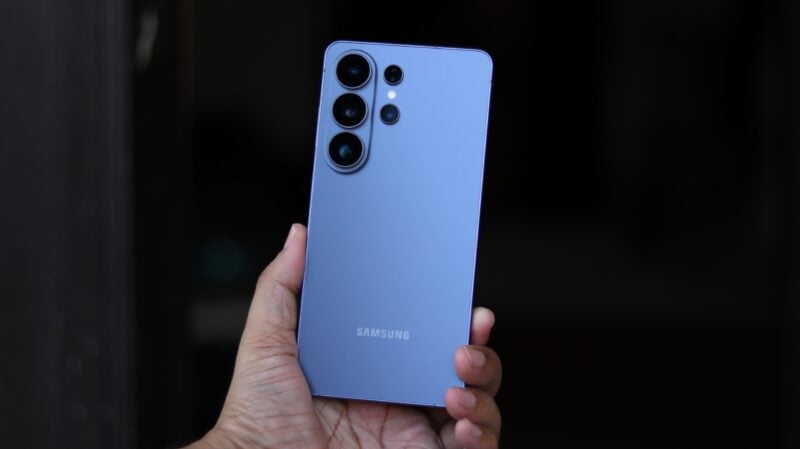
Samsung's flagship Galaxy S series and Note series phones feature the most advanced photo stabilization, with newer models offering improved OIS systems across multiple camera lenses, including the main, telephoto, and ultra-wide cameras. The Galaxy S24 Ultra and Galaxy S23 Ultra represent the current peak of Samsung's stabilization technology.
Recent flagship models include OIS on both the main camera and telephoto lenses, giving you stabilized photos whether you're shooting at normal focal lengths or zooming in on distant subjects. This dual-stabilization setup helps maintain image quality across different shooting scenarios, from close-up portraits to far-away wildlife or architecture.
Mid-range Galaxy A series phones typically include OIS on the main camera but may not have it on additional lenses. Budget-friendly models often rely more on electronic stabilization and shorter exposure times rather than optical stabilization. If photo stabilization is important for your photography needs, focusing on Galaxy S series phones will give you the most comprehensive stabilization features across all camera functions.
Understanding these differences helps you make better use of your Samsung device's camera capabilities. Whether you're capturing important family moments or recording videos of special events, knowing how your phone's stabilization works can help you get better results. At SamMobile, we regularly test and review Samsung's latest camera technologies to help you understand what your device can do and how to get the most from its features.