Last updated: February 6th, 2025 at 07:24 UTC+01:00
SamMobile has affiliate and sponsored partnerships, we may earn a commission.
Reading time: 3 minutes

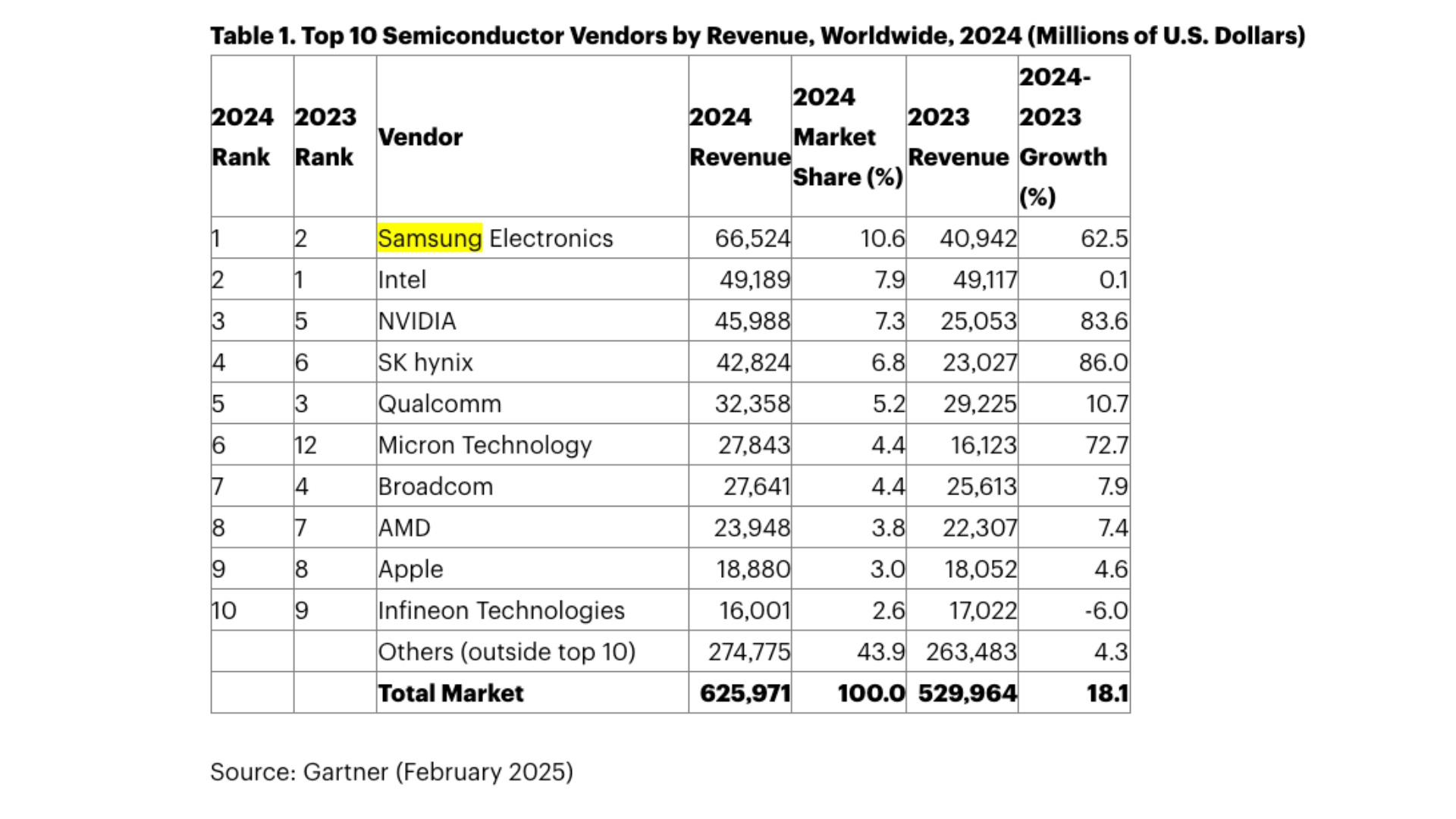
According to the latest figures from market research firm Gartner, Samsung Electronics had the biggest market share in the global semiconductor chip segment in 2024. Among semiconductor chip vendors, Samsung ranked first with a revenue of $66.5 billion and a market share of 10.5%. It grew 62.5% compared to 2023, thanks to a strong rebound in memory chip prices.
Full rankings can be seen in the image below.
If you don't know it already, Samsung makes several types of memory chips (DRAM, HBM, NAND) that are used in several types of computing and mobile devices. They are used in AI accelerator chips, automobiles, GPUs, laptops, PCs, servers, smartphones, tablets, and more.
Currently, high-bandwidth memory (HBM) chips are in huge demand, thanks to the AI boom. And Nvidia is the most important AI accelerator chip maker in the world. It makes GPUs that are extremely important to accelerate the processing in AI applications. Those GPUs use HBM chips.
Nvidia's flagship AI GPUs currently use HBM chips from SK Hynix, as Samsung's recent HBM3E chips have shown a tendency to overheat. Hence, Nvidia hasn't officially qualified Samsung's HBM chips to be used in its flagship AI GPUs. The South Korean firm has been trying to make changes to the architecture to solve overheating issues, and it is reported that the company has solved the issue and is awaiting Nvidia's clearance.
Samsung's 8-layer HBM3E chips have been certified by Nvidia, but they are currently only limited to being used in Nvidia's GPUs that are designed for the Chinese market. Samsung is concurrently working on HBM4 chips and intends to start mass production before the end of this year.
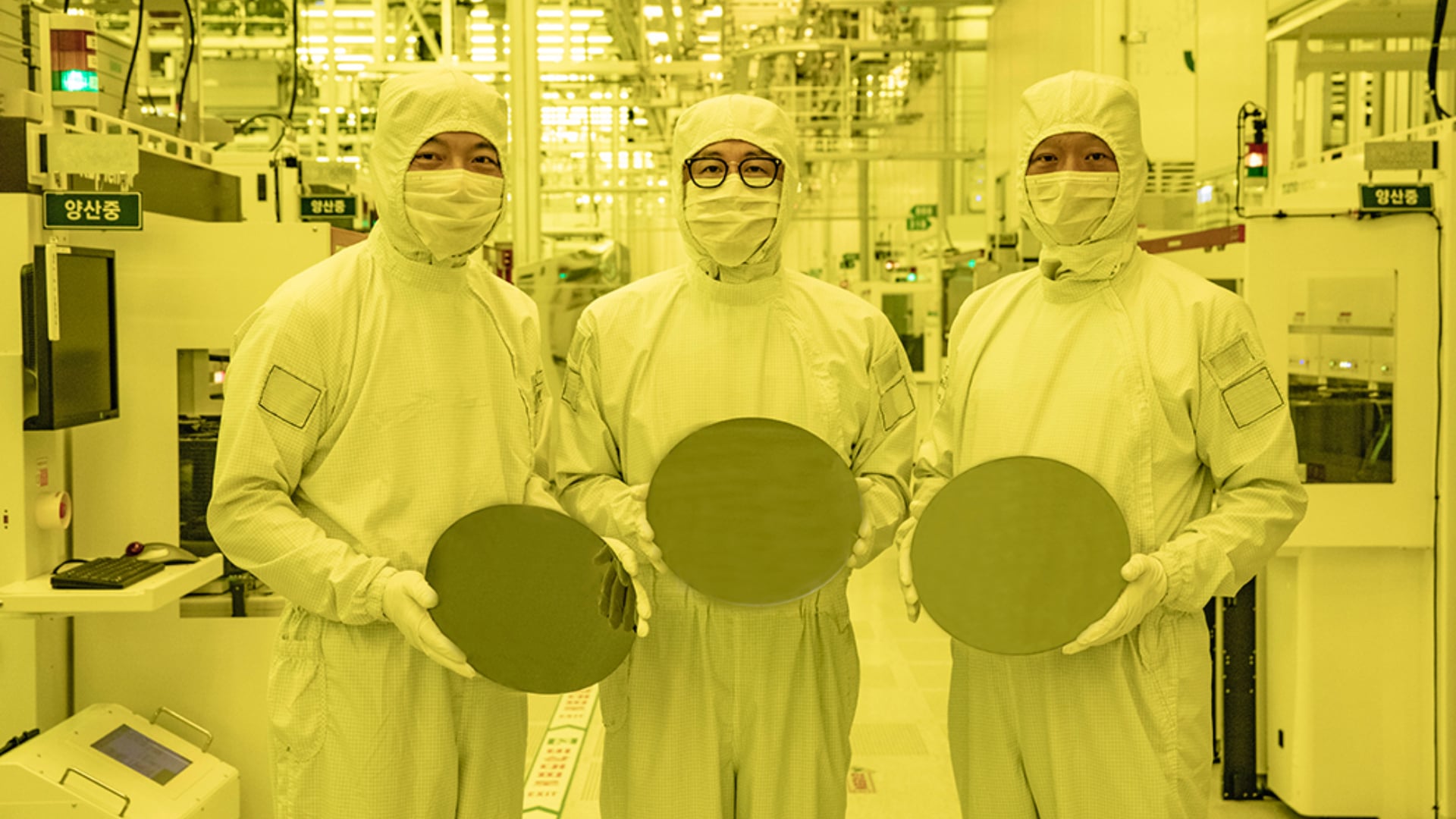
Samsung Foundry, which is the contract chip manufacturing arm of Samsung Electronics, fabricates chips for other brands, such as Nvidia, Qualcomm, and Samsung's System LSI (makes camera sensors and mobile processors) business. However, over the past couple of years, it has failed to get high-profile clients.
It has been trying to improve the yield of its 3nm chips over the past year but reportedly failed to make any significant improvement. Hence, it couldn't get contracts from AMD, Nvidia, and Qualcomm to make their chips.
It is simultaneously working on a more advanced 2nm process node and is aiming to make chips using that technology sometime next year.
Image Credits: Samsung

Asif is a computer engineer turned technology journalist. He has been using Samsung phones since 2004, and his current smartphone is the Galaxy S23 Ultra. He loves headphones, mechanical keyboards, and PC hardware. When not writing about technology, he likes watching crime and science fiction movies and TV shows.