Last updated: April 8th, 2026 at 09:40 UTC+02:00
SamMobile has affiliate and sponsored partnerships, we may earn a commission.
The South Korean firm will reportedly make 3 million foldable OLED panels for Apple in 2026.
Reading time: 3 minutes

Abhijeet Mishra / SamMobile
It has long been rumored that Samsung Display will supply foldable OLED panels for Apple’s first foldable iPhone. Now, a new report claims that Samsung Display has secured a three-year exclusive deal with Apple, meaning three generations of foldable iPhones could use only Samsung’s display panels.
A report from TheElec states that Samsung Display has signed a three-year exclusive agreement to supply foldable OLED panels for the foldable iPhone lineup. According to the report, Samsung Display proposed this condition, and Apple accepted it. Samsung’s display division reportedly justified this exclusive deal internally, as it involves supplying a key component to Apple, a direct competitor to Samsung’s mobile division.
Samsung Display is expected to supply around three million foldable OLED panels in the initial phase, which is significantly lower than the previously rumored 10 million units. Production volumes could be adjusted depending on the market response to the foldable iPhone.

Abhijeet Mishra / SamMobile
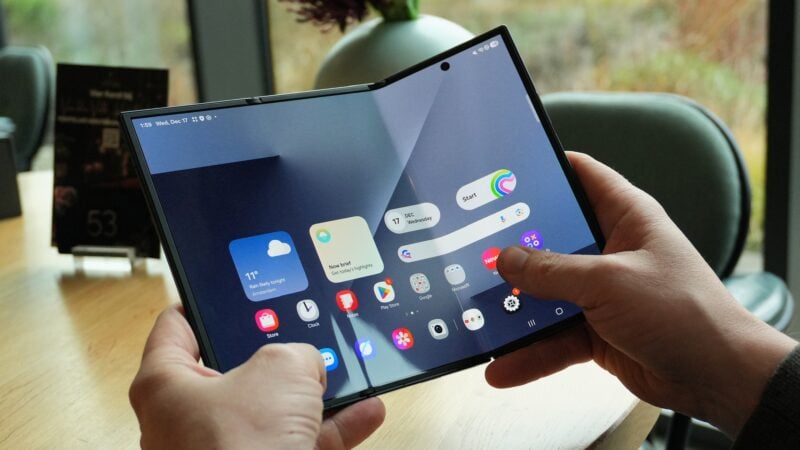
Samsung Diplay's Crease-Less foldable OLED panel showcased at CES 2026 – Source: Abhijeet Mishra / SamMobile
BOE, a Chinese rival to Samsung Display, reportedly failed to meet Apple’s strict quality requirements for foldable OLED panels. While BOE supplies foldable displays to several brands, including Huawei, LG Display, another competitor, does not yet have a proven track record in supplying foldable OLED panels for smartphones. As a result, Samsung Display appears to be Apple’s only viable supplier at this stage.
The foldable OLED panels supplied by Samsung are expected to use Color Filter on Encapsulation (CoE) technology. This approach removes polarizers and integrates color filters directly into the encapsulation layer, reducing light loss and improving brightness and color performance. The same technology is already used in Samsung’s Galaxy Z series devices.
According to the report, these panels will also use the M14 material, which is currently used in devices such as the iPhone 17 Pro Max and the Galaxy S26 Ultra.
A recent report also suggested that Apple is facing complex production challenges with its foldable iPhone, which could delay its launch from September 2026 to December 2026 or even early 2027. Meanwhile, Samsung appears to be moving ahead without delays.
The South Korean firm is reportedly preparing to launch two book-style foldable phones, the Galaxy Z Fold 8 and the Galaxy Z Fold Wide (tentative name), in July or August this year. If Apple’s timeline slips, Samsung could strengthen its lead in the foldable segment by offering more mature hardware and a wider portfolio before Apple even enters the market.
This puts Samsung in a strong position to shape the next phase of the foldable smartphone market while Apple works through its early challenges.

Asif is a computer engineer turned technology journalist. He has been using Samsung phones since 2004, and his current smartphone is the Galaxy S23 Ultra. He loves headphones, mechanical keyboards, and PC hardware. When not writing about technology, he likes watching crime and science fiction movies and TV shows.