Last updated: December 16th, 2025 at 05:21 UTC+01:00
SamMobile has affiliate and sponsored partnerships, we may earn a commission.
It is to stop apps from restarting when you switch from the bigger screen to the cover screen.
Reading time: 2 minutes

Besides hardware reliability, one of the most important things about foldable display smartphones is how they handle apps and the overall software when you transition from the cover display to the inner display and vice versa. Thankfully, the Galaxy Z TriFold handles them just fine. However, you could sometimes end up with lower-resolution screenshots.
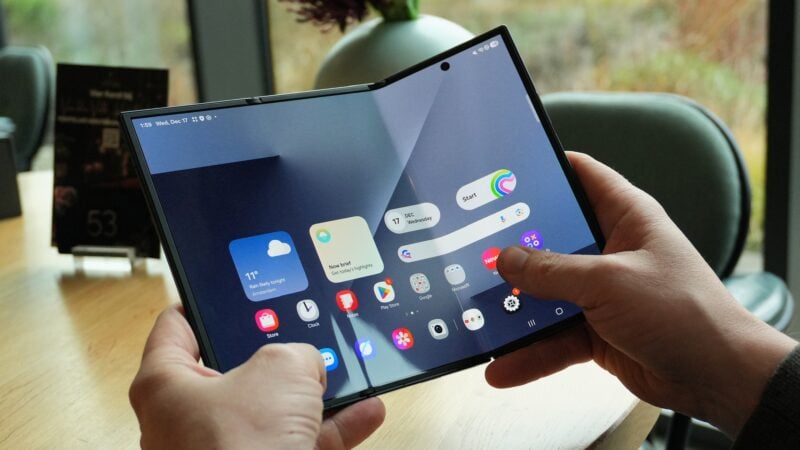
When you switch from the cover screen to the main screen, the Galaxy Z TriFold reportedly switches to the home screen instead of displaying the app you were using on the cover display. However, you can change that behavior by navigating to Settings > Display > Continue apps on main screen and then turning on the toggle. Then, if you switch from the cover screen to the foldable screen while using an app, the Galaxy Z TriFold automatically reduces the display resolution of the cover screen to 1,918 x 822 pixels.

This is to stop an app from reloading and causing display-related issues on the cover display. This behavior boils down to how Android apps are rendered behind the scenes. The Galaxy Z TriFold has a 6.5-inch cover screen and a 10-inch foldable screen, and switching an app to match those screen sizes can cause an app to reload, and when that happens, you could see visual artefacts or a blank screen for a few seconds. Switching to a lower resolution allows Samsung to stop those visual artefacts and blank screens from appearing.
Samsung mentions that its proprietary upscaling technology (likely ‘ProScaler') will preserve a similar image quality even if the actual resolution is lower. So, the images/graphics, text, and other UI elements on the display will probably look fine to your naked eye, but the raw resolution is lower. And when you capture a screenshot of the cover display, the end result will be an image with a lower resolution—1,918 x 822 pixels—than the cover display's actual resolution (2,520 x 1,080 pixels).
This issue isn't found on other Galaxy Z Fold series devices probably because the differences in cover display and foldable display sizes and pixel densities aren't as pronounced as on the Galaxy Z TriFold. Hopefully, Google will make changes in how Android app transition works on foldable phones in future releases of the Android operating system.

Asif is a computer engineer turned technology journalist. He has been using Samsung phones since 2004, and his current smartphone is the Galaxy S23 Ultra. He loves headphones, mechanical keyboards, and PC hardware. When not writing about technology, he likes watching crime and science fiction movies and TV shows.