Last updated: March 31st, 2026 at 18:35 UTC+02:00
SamMobile has affiliate and sponsored partnerships, we may earn a commission.
If only to frustrate the iPhone Fold.
Reading time: 4 minutes

Abhijeet Mishra / SamMobile
Samsung has a history of making bold hardware experiments, particularly with its foldable lineup. It's been quite the journey from the original Galaxy Fold to the refined foldable phones of today. It has repeatedly proven that it’s willing to take risks long before the rest of the industry feels comfortable doing so, particularly Apple in recent years.
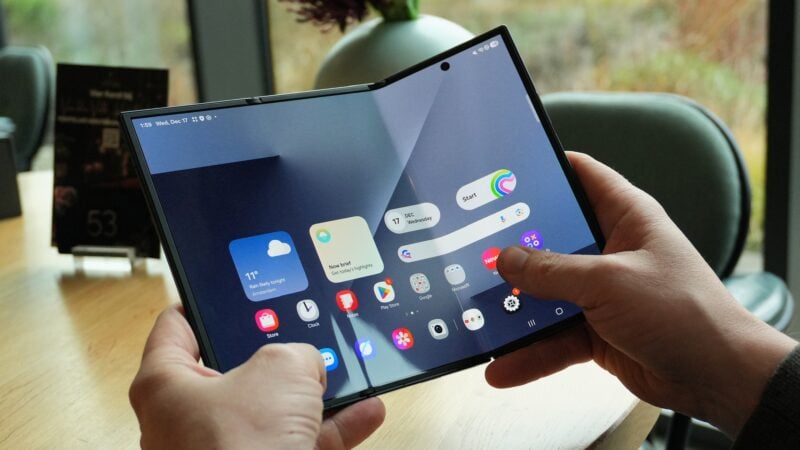
Apple still hasn't joined the foldable phone party while its first iPhone Fold is only expected to arrive later this year, likely after Samsung unveils the Galaxy Z Fold 8 and Z Flip 8 series. Even when the long-awaited foldable iPhone does arrive, it will immediately pale in comparison to the Galaxy Z TriFold, a product that enabled Samsung to comprehensively mog Apple in the foldable segment.
Samsung did make it clear that the Galaxy Z TriFold was going to be available in select markets and that too in limited quantities. The United States was one of the very few markets where it was made available. Samsung only sold the device through its website and select experience stores across the country. Only a few thousand units would be available with every stock and the device would often sell out within minutes.
The company recently confirmed that the last restock has been done in the United States and that it's now discontinuing sales of the Galaxy Z TriFold in the country. To me, that feels like a missed strategic opportunity rather than a product cycle adjustment. For the first time in years, Samsung had a device capable of decisively winning the narrative against Apple in the US.
The Galaxy Z TriFold was never meant to be a mass-market phone. Its obvious purpose from day one was to demonstrate technological leadership. Keeping the Galaxy Z TriFold around would have meant that when Apple did finally release the iPhone Fold, Samsung had a vastly superior product on the market that showcased its technological and engineering prowess much more than a conventional foldable could.
It's hard to deny that whenever Apple enters a category, the conversation resets. The company doesn’t need to ship the most advanced hardware. It only needs to ship something polished enough for the narrative to shift toward “Apple perfected it.”
Samsung, uniquely, had a counterpunch ready. Keeping the Galaxy Z TriFold available in the US, even in limited quantities, would have ensured that Apple’s first foldable arrived in a market where Samsung already offered something visibly more ambitious.
By discontinuing the Galaxy Z TriFold in the United States, Samsung risks enabling Apple to define the category's next chapter in the United States. 2026 would end up going from the year of the Galaxy Z TriFold to being the year of the first foldable iPhone.
There was never any question of the Galaxy Z TriFold eating into the sales of the Galaxy Z Fold series. Samsung obviously knew that which is why the device was offered in such limited quantities. Halo devices such as these are rarely about volume. They exist solely to shape opinions.
The TriFold could have stuck around to remind consumers and the media that Samsung remained years ahead in hardware capabilities. A first-generation iPhone Fold was never going to measure up against it. It would further highlight that while Apple is only just entering the fray, Samsung has built a mature multi-mgeneration foldable ecosystem that has stood the test of time.
Yes, it can be argued that it was a smart decision to discontinue the Galaxy Z TriFold. However, the US market is different. It's the media center of the global smartphone conversation. What stays on sale in the US continues to exist in the global tech discourse.
Had Samsung maintained the Galaxy Z TriFold as a US-exclusive or limited-availability device, it would have served as a constant reminder that Samsung defines the cutting edge of foldables.
Instead, Samsung appears to have intentionally taking its strongest visual argument against the first iPhone Fold off the market the very same year that the competitive landscape in the United States is set to change forever. Only time will tell if this ends up being the right decision.

First Samsung device: SGH-E900
Adnan Farooqui is a long-term writer at SamMobile. Based in Pakistan, his interests include technology, finance, Swiss watches and Formula 1. His tendency to write long posts betrays his inclination to being a man of few words.