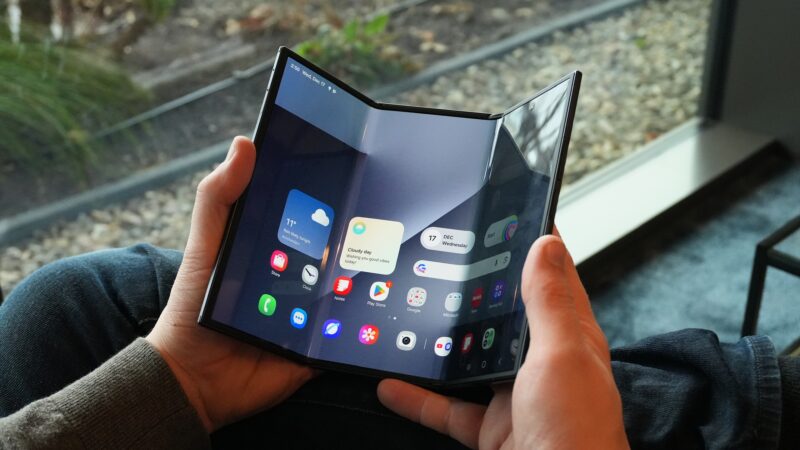
Samsung has launched the Galaxy Z TriFold, its first phone with a tri-folding design. This is the biggest change to Samsung’s foldable lineup in years and introduces a new form factor alongside the Galaxy Z Fold and Galaxy Z Flip.
The Galaxy Z TriFold is designed for users who want a large screen without giving up portability. When unfolded, it turns into a tablet-sized device. When folded, it works like a regular smartphone. Samsung clearly targets productivity-focused users with this device.
Design
The Galaxy Z TriFold uses an inward-folding design with two hinges. Both sides fold over the main display, keeping it fully protected when the phone is closed.
There is a right and a wrong way to fold the device. Samsung has added on-screen warnings and vibrations to alert users if they try to fold it incorrectly. The left side must be folded first, followed by the right side, which houses the camera module.
Despite having two hinges, the Galaxy Z TriFold is thin. When fully unfolded, it measures just 3.9mm at its thinnest point. When folded, it is 12.9mm thick, less than a Galaxy Z Flip 7 would be with a case on. Each section has slightly different thickness to make room for the hinges and hardware.
The phone weighs 309g, which is heavy for a phone but expected for a device with a 10-inch screen. Samsung also uses its most advanced hinge system yet and has reinforced the foldable display for durability. The Galaxy Z TriFold has an IP48 water resistance rating.
Unlike Samsung’s Galaxy Z Fold series, the Galaxy Z TriFold does not support Flex Mode. The dual-hinge design is meant to be used either fully folded or fully unfolded, and the phone cannot be held open at multiple angles or used halfway open.
This means features like hands-free camera previews or laptop-style use are not available without accessories such as Samsung’s official standing case or third-party cases with a kickstand.
Display
The Galaxy Z TriFold has two displays: a large internal screen and an external cover screen. The main display is a 10-inch Dynamic AMOLED 2X panel with QXGA+ resolution. It supports a 120Hz adaptive refresh rate.
The panel gets very bright, reaching up to 1,600 nits, making it easy to see in bright sunlight, though it's not as bright as the Galaxy Z Fold 7's foldable panel.
The large screen is designed for productivity. You can run three apps side by side in full screen, and apps can resize easily. When used in landscape mode, apps can show toolbars or extra controls, making tasks like email, documents, and web browsing easier.
The 6.5-inch cover display has an FHD+ resolution and also supports a 120Hz adaptive refresh rate. It is brighter than the inner screen, reaching about 2,600 nits at peak brightness, which helps outdoors. This display works for quick tasks like checking messages, taking calls, or using the camera without unfolding.
Both screens use Samsung’s Dynamic AMOLED technology for vibrant colors, deep blacks, and good visibility in different lighting. The cover screen also comes with a pre-applied anti-reflection film.
Specifications
The Galaxy Z TriFold runs on the Snapdragon 8 Elite for Galaxy chipset, a top-end Qualcomm processor with a higher clock speed for Galaxy devices. It comes with 16GB of RAM, which helps with multitasking and running heavy apps. Storage options include 512GB and 1TB using UFS 4.1 storage.
Under the hood, there's a 5,600mAh three-cell battery, the largest Samsung has put in a foldable. Samsung splits the battery across the three sections of the device to keep it balanced. The phone supports 45W wired charging, a first for a Samsung foldable. Wireless charging is also supported, along with reverse wireless charging to top up other devices like earbuds.
For connectivity, the TriFold offers 5G, LTE, Wi-Fi 7, and Bluetooth 5.4. It also supports UWB (Ultra Wideband). The phone also has stereo speakers tuned for balanced sound. Like other Samsung foldables, there is no in-display fingerprint sensor. Instead, a capacitive fingerprint sensor is embedded into the power button.
Cameras
The Galaxy Z TriFold has a triple rear camera setup identical to the Galaxy Z Fold 7. This includes a 200MP main camera with optical image stabilization, a 12MP ultra-wide camera with autofocus, and a 10MP telephoto camera with 3x optical zoom and OIS.
There are 10MP selfie cameras on both the cover screen and the inner display, making it easy to take photos or join video calls in any folding mode.
The phone can record 4K videos at 60fps using all cameras and 8K videos at 30fps using the main camera. It also supports HDR10+ video recording.
Software and features
The Galaxy Z TriFold runs Android 16 with One UI 8 out of the box. Samsung promises seven major Android OS updates, so it will be updated until at least 2032.
A key feature is Samsung DeX on the device itself. DeX gives a desktop-style interface with resizable windows, taskbar, and keyboard/mouse support without needing an external screen. This makes multitasking feel closer to a laptop experience.
Multitasking on the TriFold is strong. You can open three full apps side by side, resize app windows, and use pop-up panels. One UI also adds shortcuts, split-view options, and improved gestures.
The phone includes Samsung’s full suite of Galaxy AI features, such as generative editing tools, live translation, and smarter suggestions across apps. Features like audio eraser and generative wallpapers are included as well.
Availability and price
The Galaxy Z TriFold first went on sale in South Korea on December 12, with a starting price of around KRW 3,590,400 (about $2,500 USD).
Samsung is using a phased rollout. The phone is also launching in countries like China, Taiwan, Singapore, and the UAE. A rollout in the United States is planned for early 2026.
The Galaxy Z TriFold is available through select Samsung retail stores, allowing customers to try the device before making a purchase.
To ease concerns around durability and repair costs, Samsung is also offering a special display repair benefit for Galaxy Z TriFold buyers. According to the company, customers are eligible for a one-time display repair at a 50% discount.
Samsung has not officially shared Galaxy Z TriFold display replacement costs, but according to rumors, replacing the 6.5-inch cover display could cost between KRW 137,000 and KRW 226,000 (around $92 to $153).
The 10-inch foldable inner display is said to be far more expensive, even compared to devices like the Galaxy Z Fold 7, with replacement costs ranging from KRW 1,657,500 to KRW 1,834,500 (roughly $1,122 to $1,242).
Galaxy Z TriFold FAQ
Can the Galaxy Z TriFold be used like a normal phone?
Yes. When folded, the Galaxy Z TriFold works like a regular smartphone using its 6.5-inch cover display. You can make calls, reply to messages, use apps, and take photos without unfolding the device.
How many ways can the Galaxy Z TriFold be folded?
The Galaxy Z TriFold has two hinges and folds inward in a specific order. The left panel must be folded first, followed by the right panel. Samsung includes on-screen alerts and vibration warnings if you try to fold it the wrong way.
Can I use Samsung DeX without an external monitor?
Yes. The Galaxy Z TriFold is the first Samsung phone that can run DeX directly on its own screen. Thanks to the 10-inch display, you can use a full desktop-style interface without connecting the phone to a monitor or TV.
How many apps can the Galaxy Z TriFold run at once?
On the main 10-inch display, the Galaxy Z TriFold can run three full-sized apps side by side. Each app appears in a phone-sized window. It also supports running three apps in a mix of landscape and portrait orientation, similar to Galaxy Z Fold smartphones.
Does the Galaxy Z TriFold support the S Pen?
No. The Galaxy Z TriFold does not support the S Pen. Samsung has not added stylus support to its foldable phones so far, and that remains the case here.
Is the Galaxy Z TriFold water resistant?
The Galaxy Z TriFold has an IP48 rating, meaning it offers protection against water exposure but limited protection against dust. This is in line with Samsung’s foldable devices like the Galaxy Z Fold 7.
How durable is the Galaxy Z TriFold?
Samsung says the Galaxy Z TriFold uses its most advanced hinge system yet and includes reinforced layers in the foldable display. While it is designed for daily use, it is still a complex foldable device and should be handled with care.
Does the Galaxy Z TriFold have wireless charging?
Yes, the Galaxy Z TriFold supports wireless charging and reverse wireless charging, allowing it to charge accessories like earbuds.
How many software updates will the Galaxy Z TriFold get?
Samsung promises seven major Android OS updates for the Galaxy Z TriFold. It ships with Android 16 and One UI 8 out of the box.
Is the Galaxy Z TriFold worth buying over the Galaxy Z Fold?
The Galaxy Z TriFold is aimed at users who want maximum screen space and productivity. It offers a much larger display and more advanced multitasking than the Galaxy Z Fold, but it is also heavier, thicker when folded, and far more expensive. For most users, the Galaxy Z Fold is the more practical choice.






 Expectations vs reality: What does the Galaxy Z Fold 8's foldable screen actually feel like?
 Is Samsung building the Galaxy S27 Pro with everyone else’s features?
 A critical piece is missing from Samsung's smart home ecosystem
 Samsung could crush Apple with the Galaxy Z Fold 8 and Fold 9
 iPhone Duo pre-orders show Apple users are watching Samsung’s innovations closely
 Samsung has a reason to make fewer Galaxy phones, and it's a risk worth taking
 Even a 1TB Galaxy Z Fold 8 can cost less than a 256GB iPhone Duo
 I can't stand this One UI feature many Galaxy Z Fold users seem to love
 Why Samsung needs to double down on the bet it has made on 82 million US Galaxy devices