Is flagship-grade performance finally possible on a mid-range Galaxy smartphone? That was the primary question I wanted answered when I set out to review the Galaxy A57, since its predecessor was the most optimized mid-range Samsung phone at the time.
Is the answer yes, no, or somewhere in between? And what about everything else? Are the rest of the phone’s features good enough to justify the biggest price tag Samsung has put on a device in its premier mid-range lineup?
Design
Abhijeet Mishra / SamMobile
Samsung Galaxy A57
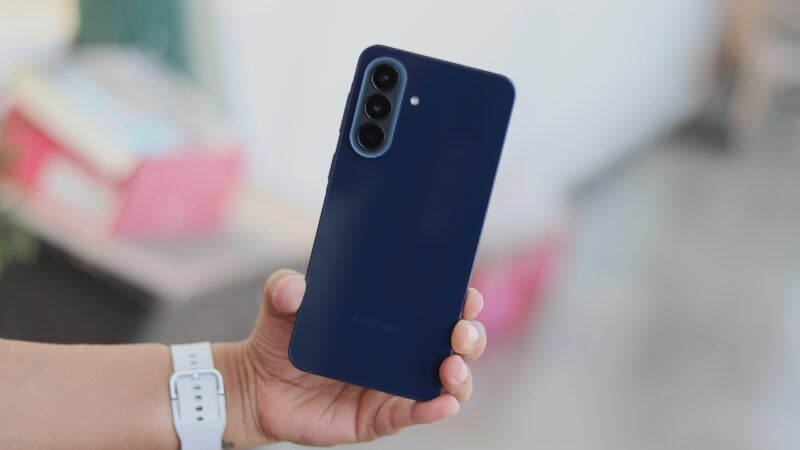
When you pick up the A57, what immediately stands out is how light it is. Somehow, Samsung has managed to shave almost 20g off the A56, making it the lightest model in the lineup since the Galaxy A52. The Galaxy A53, A54, and A56 weighed between 189g and 200g, and the Galaxy A55 was a whopping 213g. The A57? Only 179g.
Samsung has also made the A57 thinner. The A56 was already 0.8mm thinner than the A55, and Samsung found a further 0.5mm to shed. Making every new phone thinner has been one of Samsung’s primary goals over the last couple of years, and it’s a goal the company keeps achieving with impressive consistency.
When you pick up the A57, what immediately stands out is how light it is.
The Galaxy A57 is a joy to use thanks to the slimmer, lighter body. It also feels very premium to the touch thanks to the glass and metal build. It’s a shame, then, that Samsung has made a design choice that makes the phone look rather cheap: the camera rings on the back.
Abhijeet Mishra / SamMobile
Samsung Galaxy A57
As a colleague of mine pointed out, they look like they’ve been borrowed from the Galaxy A17. They simply don’t belong on a device priced upwards of €500.
For some reason, Samsung can’t seem to maintain consistency with camera ring design from year to year, and the problem isn’t limited to mid-range phones either. The Galaxy Z Fold 6 is a good example: it had cheap-looking camera rings that felt painfully out of place on a device that cost almost $2000.
Abhijeet Mishra / SamMobile
Galaxy A57
Abhijeet Mishra / SamMobile
Samsung Galaxy A57
The Galaxy A56 didn’t have this issue — its camera rings were recessed into the camera island — and Samsung should have just stuck with that rather than making such an obvious downgrade. The rings take away from what is otherwise a lovely rear panel, covered in reflective Gorilla Glass Victus+.
That said, most people will put their phone in a case, so it only matters so much. What matters more is protection against the elements. And here the A57 brings a meaningful upgrade: IP68 water and dust resistance. Compared to IP67, that means the phone can handle submersion in 1.5m of water for 30 minutes, rather than just 1m.
Display
Abhijeet Mishra / SamMobile
Galaxy A57 display
On the display front, the Galaxy A57 doesn’t bring any upgrades over the A56. It’s vibrant, gets plenty bright, has a 120Hz refresh rate, and offers a good viewing experience whether you’re watching videos or browsing the web.
The good news, though, is that Samsung has finally done something about the ugly bezels that have plagued previous models in the lineup. They’ve been reduced on all sides, and while the chin is still the thickest of the four, it’s a long overdue step in the right direction.
Abhijeet Mishra / SamMobile
Galaxy A57
The A57 seems to have carried over the stereo speaker setup from the A56. It sounds good for a mid-range phone, but it doesn’t get as loud as I’d like, and bass reproduction leaves something to be desired.
Camera
Abhijeet Mishra / SamMobile
Samsung Galaxy A57
The Galaxy A57 uses the same rear camera setup as its predecessor: a 50MP primary camera, a 12MP ultrawide camera, and a 5MP macro camera.
Unsurprisingly, image quality is largely unchanged. The A57 captures excellent photos in daylight, with a wide dynamic range and accurate colors. Low-light performance is solid as well, at least when Night mode kicks in automatically.
Abhijeet Mishra
0.6x (ultrawide)
Abhijeet Mishra
1x
Abhijeet Mishra
1x
Abhijeet Mishra
1x
Abhijeet Mishra
0.6x
Abhijeet Mishra
1x
Abhijeet Mishra
0.6x
Abhijeet Mishra
1x
Abhijeet Mishra
0.6x
Abhijeet Mishra
1x
Abhijeet Mishra
0.6x
Abhijeet Mishra
1x
The ultrawide camera continues to deliver more than usable results in good lighting, though quality drops in low-light conditions. The macro camera, meanwhile, still feels unnecessary on a phone at this price point. It’s fun to experiment with at first, but most users will likely ignore it after a while.
Abhijeet Mishra
2x portrait
Abhijeet Mishra
1x portrait
Abhijeet Mishra
2x portrait
Abhijeet Mishra
1x portrait
A dedicated zoom camera is still missing, which is disappointing given that some competing devices in this segment offer one. As before, it feels like Samsung is holding back here to avoid stepping on the toes of its Galaxy S FE lineup.
A dedicated zoom camera is still missing, which is disappointing.
Where the Galaxy A57 does benefit is in camera responsiveness. Samsung made big improvements with the A56 by significantly reducing shutter lag and speeding up lens switching, and those gains have carried over. The camera app feels quick and responsive, at least compared to older mid-range Galaxy phones.
The front camera remains the same as the A56—a 12MP sensor—and continues to perform well, delivering detailed selfies with good dynamic range in both daylight and indoor conditions.
Abhijeet Mishra
Selfie
Abhijeet Mishra
Portrait selfie
Video recording is largely unchanged as well. You’re still limited to 4K at 30 fps, and there’s no support for HDR video recording. Samsung says the camera offers “richer dynamic range with advanced sensor HDR technology,” but that feels more like marketing speak. Video quality itself is perfectly fine. It gets the job done, but it’s not going to blow you away.
Performance
With the Galaxy A56, Samsung made major strides toward finally making a mid-range Galaxy phone feel like a flagship in day-to-day use. Animations were surprisingly smooth throughout the interface, something people simply didn’t expect from a mid-range Samsung device.
It was far from perfect, though. There was enough stutter in normal operation to remind you that, with Samsung, consistently smooth performance still meant spending at least $700–$800.
With the Galaxy A57, whether it’s because the Exynos 1680 is more powerful, Samsung has pushed further software optimizations, or a mix of both, the company has taken another step toward closing the performance gap between its mid-range and flagship phones.
Abhijeet Mishra / SamMobile
Asphalt Legends on the Galaxy A57
Is stutter and lag completely gone? Not quite. For example, if you swipe down from the right edge of the screen to open the quick panel directly, the animation still has a slight hesitation. And if you’re running navigation in the background, the phone can sometimes take a second to respond to your touch.
In normal use, the A57 often feels like a high-end phone.
But those moments where performance feels iffy are few and far between. In normal use, the A57 often feels like a high-end phone. It’s a shame it took Samsung 17 years from its first Android phone to deliver this level of performance in the mid-range. But it’s great news for anyone considering the Galaxy A57 as their next device.
What about gaming? Samsung says the Exynos 1680 offers up to 15% better GPU performance than the A56’s Exynos 1580, but I wouldn’t say the difference is particularly noticeable in real-world use. This is still a mid-range phone, so while some games can hit 120 fps on a Galaxy S25 or Galaxy S26 at the highest graphics settings, the A57 will often hover just below 60 fps.
But if you stick with the default graphics settings in heavy games, the A57 performs well, whether you’re playing Call of Duty or good old Asphalt Legends. And for most people, that’s perfectly fine — they’re not going to be playing the most demanding titles all the time.
As far as cooling is concerned, the Galaxy A57 should, in theory, be better, thanks to a 13% larger vapor chamber compared to the A56. In practice, however, the thinner design seems to offset those gains, and cooling can be a bit of a mixed bag when the phone is pushed.
During demanding games or long video recording sessions, it warms up faster than the A56. Overall, though, it holds up about as well as its predecessor, and you won’t run into many situations where the phone gets hot to the touch. That’s especially worth noting given that the Exynos 1680 packs a more powerful GPU inside a thinner body.
Software
Abhijeet Mishra / SamMobile
Samsung Galaxy A57
Like the Galaxy S26 series, the Galaxy A57 comes preloaded with One UI 8.5 (Android 16). While performance is now much closer to a flagship than on previous models, Samsung hasn’t moved the needle much on the software front, especially when it comes to AI features.
The Galaxy A57 doesn’t get the Galaxy AI suite found on Samsung’s flagship phones. Instead, it offers what Samsung calls Advanced Intelligence, a collection of features that may sound like AI but aren’t all that sophisticated in practice.
For example, Galaxy AI’s impressive object eraser for photos isn’t available here. You can still remove objects from images, but there’s no option to move them around, the same as older models like the Galaxy A55 and A56.
Compared to the Galaxy A56, there’s only one notable addition: voice transcription. Even that is limited in scope. Unlike on Samsung’s flagships, transcription doesn’t work everywhere. You only get it for voice recordings and call recordings.
Abhijeet Mishra / SamMobile
Advanced Intelligence features on the Galaxy A57
Existing Advanced Intelligence features include Best Face, which lets you pick the best frame from motion photos; AI Select for capturing parts of the screen and getting context-aware suggestions; Read Aloud for webpages in the Samsung Internet app (now called Samsung Browser); the ability to create custom camera filters based on existing images; and Auto Trim, which automatically extracts key moments from recorded videos.
The rest of the software experience is largely similar to other Samsung smartphones, with the exception of high-end features like Samsung DeX. You can watch the video below to learn more about One UI 8.5. Finally, the Galaxy A57 will be supported for six years, with both major OS upgrades and security updates included.
Battery and charging
Abhijeet Mishra / SamMobile
Galaxy A57
Over the last couple of years, Samsung has made a habit of promising “up to two days of battery life” on the product pages for both its mid-range and flagship phones.
For the Galaxy A5x lineup, that claim first appeared with the Galaxy A54, though it wasn’t particularly realistic there. The Galaxy A55 came closer, and the Galaxy A56 was the first to truly deliver on that promise in a meaningful way.
The Galaxy A57 doesn’t quite live up to that same standard. With mixed use, it comfortably lasts a full day, but reaching two days on a single charge requires very light usage.
Out of the box, at least, it doesn’t feel as impressive as the A56 in this regard. This seems to be the price you pay for the smoother UI performance. That and the fact that the Exynos 1680 adds an extra performance core compared to the chip used in the A56.
That said, battery life is still excellent overall. Even with fairly heavy use, it’s not easy to drain the phone in a single day, whether you’re on Wi-Fi or spending hours on mobile data. And as the phone learns your usage patterns over time, there’s a chance things could improve further.
Charging speeds remain unchanged from the A56, with support for 45W fast charging. In my testing, starting from 1%, the phone charged to 24% in 10 minutes, 60% in 30 minutes, and 96% in an hour.
The A56 was a bit finicky about cables and their power ratings, but the A57 is far less picky. It works just fine with standard 3A cables, which are what most people will be using anyway.
Verdict
Abhijeet Mishra / SamMobile
Samsung Galaxy A57
The Galaxy A57 is Samsung’s best mid-range phone yet, and if that’s the category you’re shopping in, it’s an easy recommendation. The bigger question is whether it’s the right phone to buy.
At $500+, the Galaxy S25 FE has to be included in the conversation. For around $100 more, it offers proper flagship hardware that the A57 can only approximate. And in many markets, frequent discounts bring the S25 FE even closer to the A57’s price, making that decision harder to ignore.
If the S25 FE is within reach, it’s the better long-term buy. But if you’re sticking to a mid-range budget, or are willing to wait for the A57’s price to drop a little, the A57 is the best answer Samsung has ever offered in this segment.
Samsung Galaxy A57
What we like
Premium design, impressively light build
Bright 120Hz AMOLED display, now with slimmer bezels
Feels like a high-end phone in general use
Primary camera does a good job in most lighting conditions
Good selfie camera
Fast gaming performance, good cooling
Great battery life, 45W charging
One UI 8.5 (Android 16) preloaded, six years of software updates






 Expectations vs reality: What does the Galaxy Z Fold 8's foldable screen actually feel like?
 Is Samsung building the Galaxy S27 Pro with everyone else’s features?
 A critical piece is missing from Samsung's smart home ecosystem
 Samsung could crush Apple with the Galaxy Z Fold 8 and Fold 9
 iPhone Duo pre-orders show Apple users are watching Samsung’s innovations closely
 Samsung has a reason to make fewer Galaxy phones, and it's a risk worth taking
 Even a 1TB Galaxy Z Fold 8 can cost less than a 256GB iPhone Duo
 I can't stand this One UI feature many Galaxy Z Fold users seem to love
 Why Samsung needs to double down on the bet it has made on 82 million US Galaxy devices